Babylon
This article is written in English. Choose a language to open an automatic translation by Google Translate. Automatic translations can sometimes get historical names and dates wrong — for full accuracy, read the original English article.
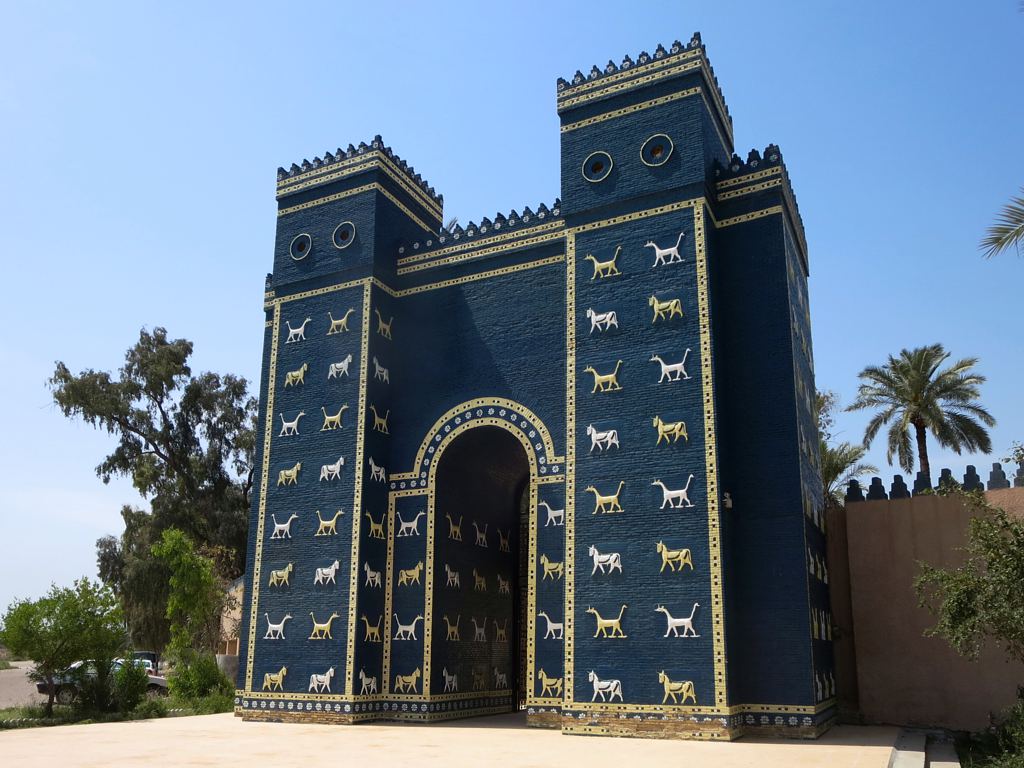
Image: David Stanley · CC BY-SA 3.0 · Wikimedia Commons
Babylon was one of the most famous cities of the ancient world. It stood on the River Euphrates in what is now Iraq, more than 4,000 years ago.
At its greatest, Babylon was a huge city of temples, palaces and high walls — the largest and most dazzling city of its age. People still remember it for its wise law-maker Hammurabi, for the bright blue Ishtar Gate, and for the famous Hanging Gardens.
Key Facts
- ['Where', 'On the River Euphrates, in modern Iraq']
- ['First great age', 'About 1800 BCE, under Hammurabi']
- ['Famous law', 'The Code of Hammurabi']
- ['Second great age', 'About 600 BCE, under Nebuchadnezzar II']
- ['Famous gate', 'The Ishtar Gate, covered in blue glazed brick, built about 575 BCE']
- ['Great tower', 'Etemenanki, a seven-storey ziggurat']
- ['Famous wonder', 'The Hanging Gardens of Babylon']
Hammurabi and his laws
Babylon first became powerful under King Hammurabi, who ruled from about 1792 to 1750 BCE. He joined many small kingdoms into one empire.
Hammurabi is most famous for his law code, carved on a tall stone pillar. It set out rules and punishments for trade, family life and crime, so everyone could see the law.
The city of Nebuchadnezzar
About 1,000 years later, King Nebuchadnezzar II made Babylon great again. Double walls protected the city, so wide, writers claimed, that a chariot could turn around on top of them. Nine great gates pierced the walls, and the grandest was the Ishtar Gate, blazing blue with rows of bulls and dragons in shining brick. Through it ran the Processional Way, lined with lions, where the gods' statues were carried during the Akitu New Year festival.
At the city's heart stood the temple of Marduk, Babylon's chief god, and beside it rose Etemenanki — a massive stepped tower that many scholars connect with the story of the Tower of Babel. Tradition says Nebuchadnezzar also built the Hanging Gardens — a mountain of green terraces — for his wife, who missed the hills of her home.
Daily life, fall and rediscovery
Babylon may have held around 200,000 people — merchants, priests, scribes, craftsmen and soldiers from across the empire. Its markets traded grain, dates, wool, silver and spices, and its astronomer-priests kept careful records of the Moon and planets on clay tablets, records so good that Greek astronomers used them centuries later.
In 539 BCE, Cyrus the Great of Persia took Babylon without a great battle, and the city became part of the Persian Empire. Babylon slowly lost its importance; Alexander the Great dreamed of restoring it, but died there in 323 BCE. Its ruins were found again by archaeologists in the 1800s and 1900s, and the Ishtar Gate was rebuilt in Berlin's Pergamon Museum, where it still glows blue today.
The animals on the Ishtar Gate include the mushhushshu — a dragon with a snake's head, lion's front legs, eagle's back feet and a scorpion's sting in its tail.
Related Topics
Sources
Reviewed: 22 November 2026
Read this article in the interactive Pastloom reader →