The Battle of Gallipoli
This article is written in English. Choose a language to open an automatic translation by Google Translate. Automatic translations can sometimes get historical names and dates wrong — for full accuracy, read the original English article.
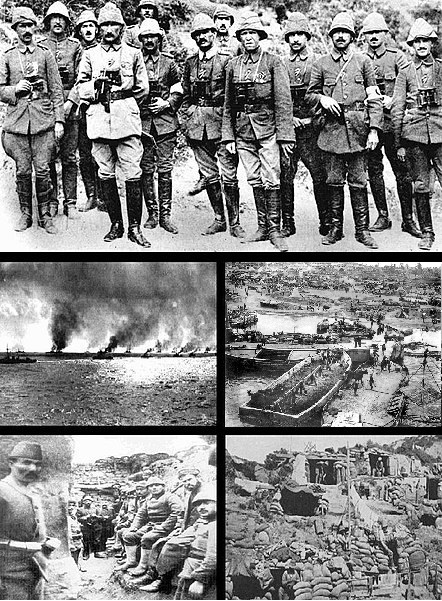
Image: LoudHmen · Public domain · Wikimedia Commons
The Battle of Gallipoli was a long campaign of the First World War, fought in 1915–16 on the Gallipoli peninsula in Turkey. Britain, France and their empires tried to knock the Ottoman Empire out of the war by capturing its capital, Constantinople.
The plan failed. Ottoman soldiers defended their homeland fiercely, and after eight months the attackers evacuated. Gallipoli became a founding story for Australia and New Zealand — and it made the reputation of the Ottoman commander Mustafa Kemal, the future founder of modern Turkey.
Key Facts
- ['Dates', 'February 1915 to January 1916; the landings began on 25 April 1915']
- ['Place', 'The Gallipoli peninsula and the Dardanelles, Ottoman Turkey']
- ['Sides', 'Britain, France, Australia, New Zealand and India against the Ottoman Empire']
- ['Ottoman hero', 'Mustafa Kemal, later known as Atatürk']
- ['Casualties', 'About half a million men, all sides, killed and wounded']
- ['Remembered', 'ANZAC Day, 25 April, in Australia and New Zealand']
The plan to reach Constantinople
The Allies hoped to force a sea route through the Dardanelles straits to supply Russia and threaten the Ottoman capital. A purely naval attack in March 1915 failed when mines sank three battleships in a single day.
So soldiers would land on the Gallipoli peninsula and clear the forts from behind. The First Lord of the Admiralty, Winston Churchill, was the plan's strongest supporter.
The landings and the deadlock
On 25 April 1915, Allied troops landed at Cape Helles and at the cove soon named ANZAC Cove. Ottoman defenders held the high ground above the beaches, and a young officer, Mustafa Kemal, led counterattacks that stopped the advance in its first hours.
The campaign settled into trench warfare like the Western Front — with worse heat, flies, thirst and disease. A great August offensive failed too, and by winter, storms and frostbite added to the suffering.
Evacuation and memory
The most successful part of the campaign was its end. In December 1915 and January 1916, the Allied armies slipped away by night in near silence, with barely a life lost — the sleeping defenders woke to empty trenches.
Churchill resigned over the failure. But Gallipoli is remembered with honour on all sides: as the birthplace of national identity in Australia and New Zealand, and in Turkey as a great defensive victory where Atatürk's fame began.
The evacuation of Gallipoli was so quiet and clever that Ottoman defenders woke one morning to find the trenches opposite them completely empty — tens of thousands of men had slipped away by night.
Related Topics
Sources
Reviewed: 22 November 2026
Read this article in the interactive Pastloom reader →