This article is written in English. Choose a language to open an automatic translation by Google Translate. Automatic translations can sometimes get historical names and dates wrong — for full accuracy, read the original English article.
Battle of Thermopylae and movements to Salamis, 480 BC. Image: The Department of History, United States Military Academy · Public domain · Wikimedia Commons
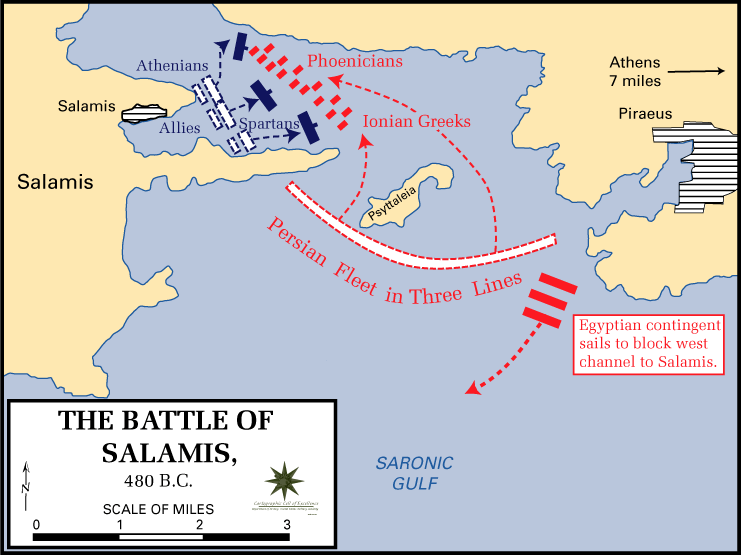
In 480 BCE, a few weeks after Thermopylae, the fate of Greece was decided at sea. In the narrow waters beside the island of Salamis, near Athens, a smaller Greek fleet faced the great navy of Persia.
The Greek victory at Salamis was one of the most important sea battles in history. It broke Persia's invasion and saved the Greek city-states — and with them, ideas like democracy and philosophy that still shape our world.
Key Facts
['When', '480 BCE, in September']
['Where', 'The straits of Salamis, near Athens']
['Side one', 'Greek city-states, led by Athens']
['Side two', 'The Persian Empire of Xerxes I']
['Greek ships', 'About 370 triremes']
['Persian ships', 'About 600 to 800 — but crowded into narrow water']
Athens abandoned
After Thermopylae, the Persians marched into Athens and burned the empty city. The Athenians had escaped by ship to the island of Salamis, where the combined Greek fleet gathered in the narrow strait.
The Greek commanders argued about whether to fight or retreat. The Athenian leader Themistocles insisted they must fight at Salamis, where the water was tight and the bigger Persian fleet could not use its numbers. A message tricked Xerxes into sending his ships into the strait.
The trap in the straits
The Persian fleet rowed into the narrow channel, where its ships became crowded and confused. The Greek triremes, smaller and faster, charged in good order, ramming enemy ships with their bronze beaks.
King Xerxes watched the disaster from a throne on the shore. Persia lost perhaps 200 to 300 ships; the Greeks lost about 40. The sea road that fed the Persian army was now in danger.
The turning point
Xerxes took most of his fleet home, and the next year Greek soldiers destroyed his remaining army at Plataea. The great invasion was over, and Greece stayed free.
Salamis showed that clever planning and the right ground — or water — can defeat a far larger force. Themistocles' victory is still studied in naval schools today.
Did You Know?
The Greek playwright Aeschylus fought at Salamis himself — and later wrote a famous play, The Persians, about the battle, told from the side of the defeated enemy.