This article is written in English. Choose a language to open an automatic translation by Google Translate. Automatic translations can sometimes get historical names and dates wrong — for full accuracy, read the original English article.
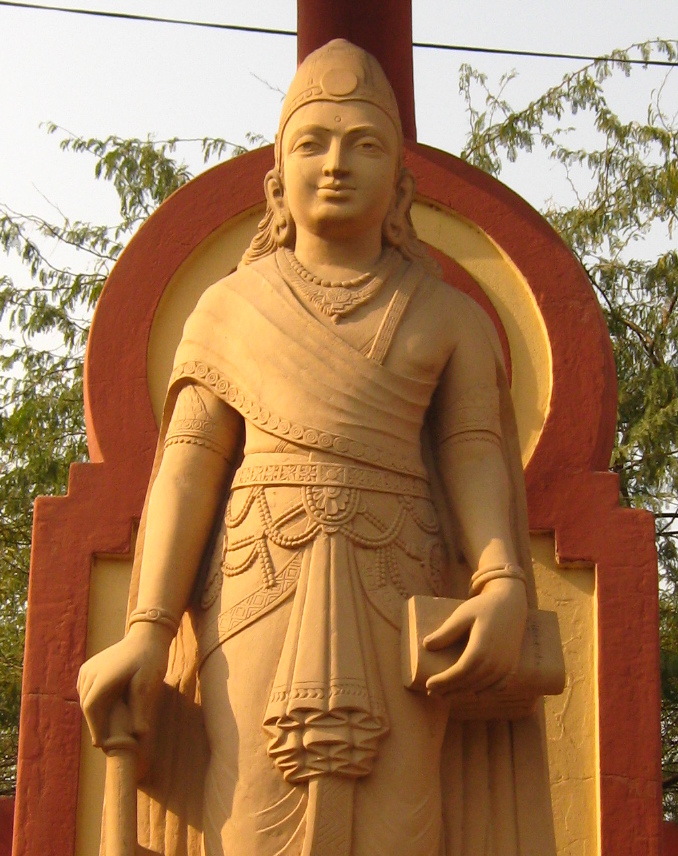
Founder of the Maurya Empire (340–295 BCE). Image: आशीष भटनागर at Hindi Wikipedia · Public domain · Wikimedia Commons
Chandragupta Maurya was the founder of the Maurya Empire — the first great empire to rule most of India. Around 321 BCE, as a young man, he overthrew a powerful king and built an empire that stretched from Afghanistan to Bengal.
His guide was the brilliant teacher Chanakya, whose book on statecraft, the Arthashastra, is still studied today. Chandragupta's grandson was Ashoka, one of the most famous kings in Indian history.
Key Facts
['Born', 'About 350 BCE']
['Founded', 'The Maurya Empire, about 321 BCE']
['Capital', "Pataliputra (today's Patna)"]
['Adviser', 'Chanakya, also called Kautilya']
['Famous victory', 'Defeated Seleucus, a general of Alexander the Great, about 305 BCE']
['Died', 'About 297 BCE — tradition says he ended his life as a Jain monk']
The young man and the teacher
Stories say Chandragupta met the teacher Chanakya after Chanakya was insulted by the Nanda king of Magadha. Chanakya saw the young man's talent and trained him to take the throne.
With Chanakya's clever plans, Chandragupta raised an army, defeated the Nandas, and took Pataliputra. Alexander the Great had recently left north-west India in confusion — and Chandragupta gathered those lands into his empire too.
An empire run like a clock
Chandragupta ruled from a vast wooden-walled capital guarded by towers and a moat. The Greek ambassador Megasthenes, sent by Seleucus, described the city's markets, officials and armies in his book Indica.
About 305 BCE Chandragupta defeated Seleucus himself. In the peace, he gained lands in Afghanistan, gave Seleucus 500 war elephants, and the two royal families joined in marriage. Spies, tax officers and governors held the great empire together.
The king who walked away
Indian tradition says that late in life Chandragupta gave up his throne, became a Jain monk, and travelled south with the teacher Bhadrabahu to Shravanabelagola in today's Karnataka.
There, it is said, he fasted to death in the Jain manner about 297 BCE. The empire he founded passed to his son Bindusara — and then to his grandson, Ashoka the Great.
Did You Know?
The 500 war elephants Chandragupta gave to Seleucus were marched west and helped Seleucus win a great battle in today's Iraq — Indian elephants deciding a war far from India.