This article is written in English. Choose a language to open an automatic translation by Google Translate. Automatic translations can sometimes get historical names and dates wrong — for full accuracy, read the original English article.
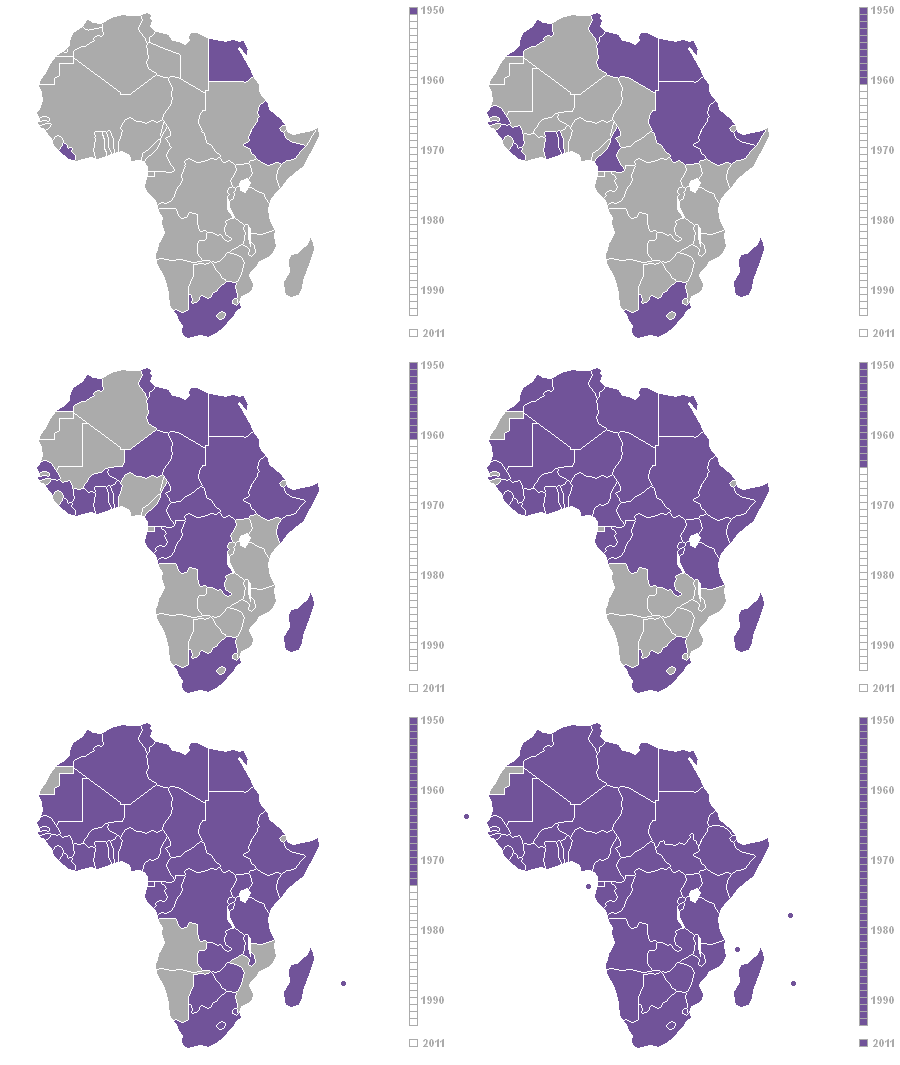
Order of independence of African nations 1950-1993, as listed on List of countries by date of nationhood . Made in photoshop from various historical maps on wikipedia all based on Vardion 's… Image: No machine-readable author provided. Roke~commonswiki assumed (based on copyright claims). · CC BY-SA 3.0 · Wikimedia Commons
Decolonisation was the ending of the great European empires in Asia and Africa after the Second World War. Between the 1940s and the 1970s, dozens of colonies won independence and became new nations.
It was one of the biggest changes in world history: the map of the world was redrawn, and hundreds of millions of people gained the right to govern themselves.
Key Facts
['Main period', '1945 – 1975']
['Landmark year', '1947 — India and Pakistan become independent']
["Africa's big year", "1960 — 17 new nations, the 'Year of Africa'"]
['Key leaders', 'Gandhi and Nehru (India), Nkrumah (Ghana), Sukarno (Indonesia) and many more']
['New world body', 'The United Nations grew from 51 members in 1945 to 144 by 1975']
['Last big case', 'Portuguese colonies in Africa freed in 1975']
Why the empires ended
The Second World War left Britain and France weakened, while their colonies had supplied soldiers and resources — and now demanded the freedom the war had been fought for, in their own lands.
Independence movements had been growing for decades: Gandhi's non-violent campaigns in India, nationalist parties in Africa and Asia, and new ideas of self-rule spread by the United Nations, founded in 1945.
Independence, country by country
India and Pakistan won independence from Britain in 1947, though the joy was shadowed by Partition, which displaced millions. Indonesia and Vietnam declared independence in 1945 and had to fight to keep it.
In 1957 Ghana, led by Kwame Nkrumah, became the first colony in sub-Saharan Africa to win independence from Britain, inspiring the continent. In 1960 alone, seventeen African nations joined the United Nations. Algeria won freedom from France in 1962 after a long and bitter war.
A new world map
Decolonisation was rarely simple. New nations often inherited borders drawn by colonisers, weak economies and Cold War pressure to take sides — many joined the Non-Aligned Movement to stay independent of both superpowers.
Yet the change was enormous and permanent. The age when a few European capitals ruled most of Asia and Africa was over, and the world's peoples now sat, at least in law, as equals in the United Nations.
Did You Know?
When the United Nations began in 1945 it had 51 member states. Decolonisation more than doubled the world body within a generation.