This article is written in English. Choose a language to open an automatic translation by Google Translate. Automatic translations can sometimes get historical names and dates wrong — for full accuracy, read the original English article.
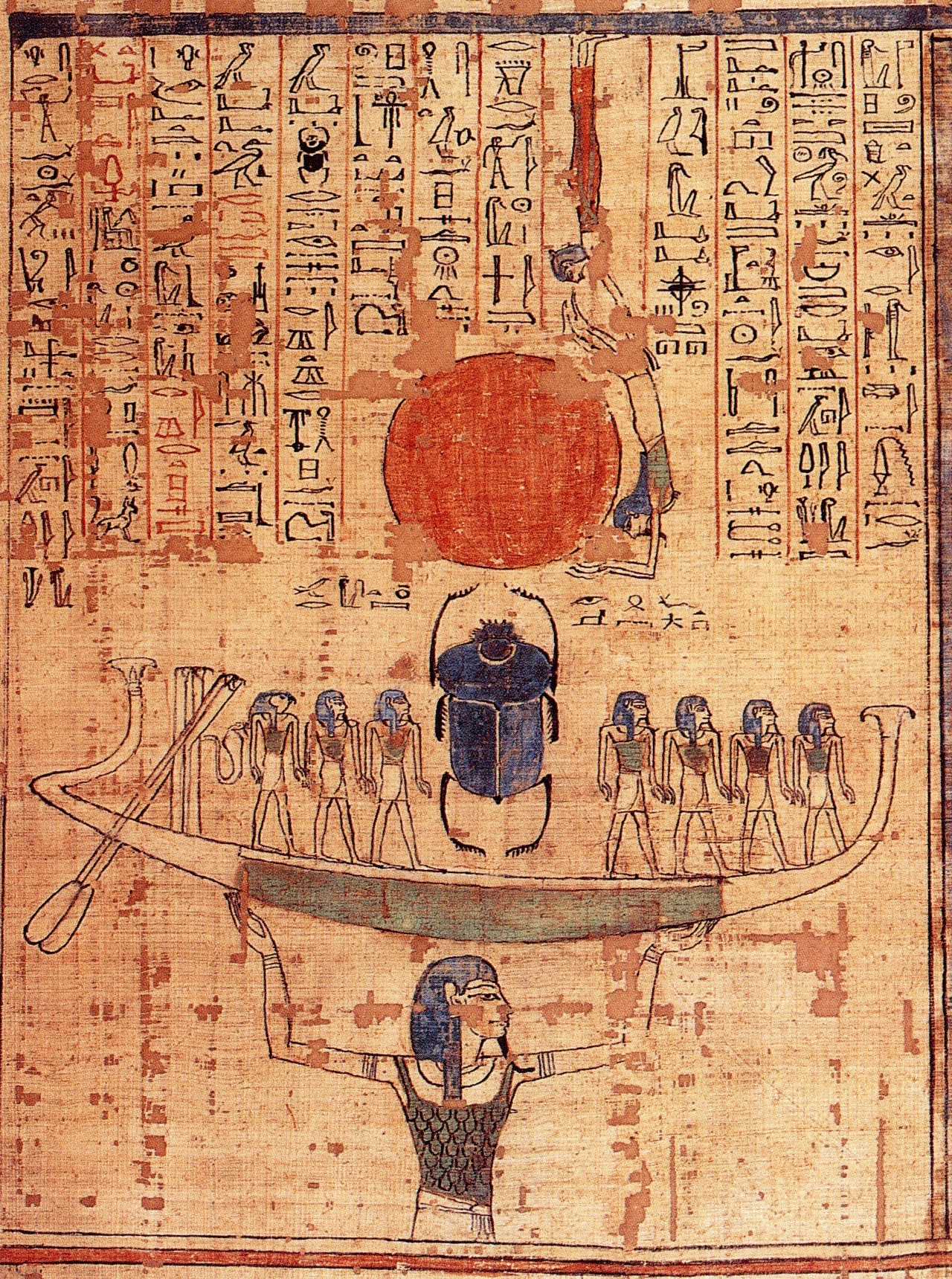
Nun, god of the waters of chaos, lifts the barque of the sun god Ra (represented by both the scarab and the sun disk) into the sky at the beginning of time. Image: Original author unknown · Public domain · Wikimedia Commons
Egyptian mythology is the set of stories that people in ancient Egypt told about their gods and about how the world began. Among the best-known figures are Ra, the sun god, Osiris and Isis, and Anubis, who was linked with mummies and the dead.
These stories were pictured on temple walls and written in hieroglyphs for more than 3,000 years. They shaped Egyptian temples, festivals, burial customs and the famous tombs of the pharaohs.
Key Facts
['Sun god', 'Ra, who was said to sail across the sky']
['Famous pair', 'Osiris and Isis']
['God linked with the dead', "Anubis, shown with a jackal's head"]
['Sacred writing', 'Hieroglyphs on temples and tombs']
Ancient Egyptians honoured many gods, often shown with animal heads — Horus with a falcon's head, Bastet as a cat, Sobek with a crocodile's head. Each city had its own special god, and great temples were built as their homes.
One central story told how Osiris was killed by his brother Set and brought back to life by his wife Isis, becoming ruler of the world of the dead. Their son Horus then fought Set — and living pharaohs were linked with Horus, and with Osiris after death.
Stories of creation and the sun
Different Egyptian cities told creation in different ways. At Heliopolis, the story began with the god Atum rising from dark waters; at Memphis, the god Ptah was said to create by speaking.
Every day, the stories said, Ra travelled across the sky in a boat, bringing light, and every night he passed through the dark underworld and rose again at dawn — a picture of the sun's daily journey and of life beginning again.
Myths and the afterlife
Belief in life after death stood at the centre of Egyptian religion. The dead were mummified, and tombs were filled with food, furniture and written spells — such as those in the collection now called the Book of the Dead — to help the dead on their journey.
When Egypt came under Greek and then Roman rule, its old stories mixed with Greek ones, and temples kept the ancient rites going until about 1,500 years ago. The myths are still read today from the carvings and papyri the Egyptians left behind.
Did You Know?
Egyptian embalmers worked under the sign of Anubis — priests sometimes wore a jackal mask of the god while preparing a mummy.