This article is written in English. Choose a language to open an automatic translation by Google Translate. Automatic translations can sometimes get historical names and dates wrong — for full accuracy, read the original English article.
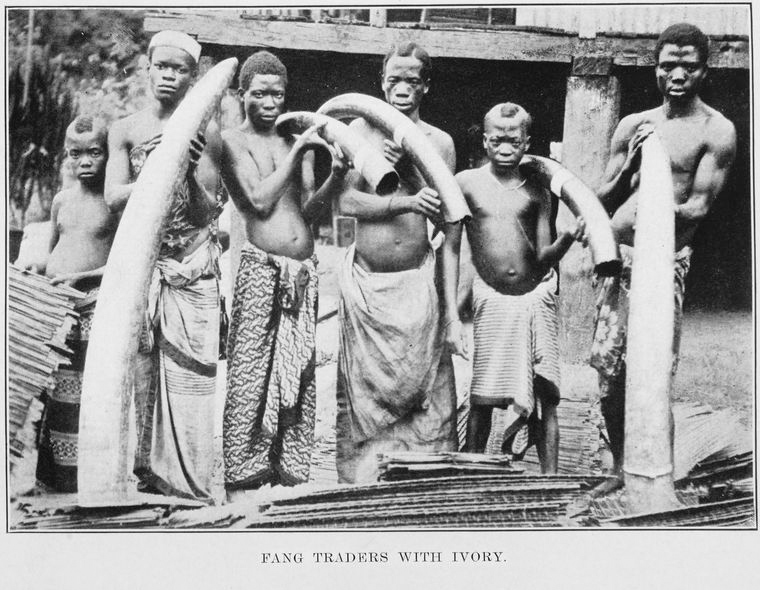
Fang traders with ivory. From The fetish folk of West Africa (published ). Image: Unknown via Fleming H. Revell Company · Public domain · Wikimedia Commons
Our library already tells the story of elephants in war, work and royal ceremony. This article follows a sadder thread: ivory. Elephant tusks are made of ivory, a smooth white material that people have carved into treasures for thousands of years.
The hunger for ivory killed millions of elephants and pushed them towards danger. The fight to stop the ivory trade became one of the great conservation battles of modern times.
Key Facts
['What ivory is', 'The material of elephant tusks — actually giant front teeth']
['Ancient treasures', 'Ivory carvings prized in Egypt, India, China and Europe']
['Piano keys', 'For over a century, piano keys were covered with ivory']
['The crisis', "In the 1970s–80s, poaching cut Africa's elephant herds roughly in half within about a decade"]
['World ban', 'International trade in ivory banned in 1989']
['Today', 'Most countries ban ivory sales, but poaching has not fully stopped']
White gold of the ancient world
Carvers have loved ivory for 5,000 years: it is smooth, strong and takes fine detail. Phoenician traders carried it across the Mediterranean, and kings from Solomon onwards prized ivory thrones and inlaid furniture.
In the 1800s, factories in Europe and America turned ivory into piano keys, billiard balls, combs and handles — and demand for tusks exploded.
The age of slaughter
With modern guns and high prices, hunters and poachers killed elephants on a terrible scale. In the 1970s and 1980s, Africa's elephants fell from well over a million to roughly half that number.
In 1989, Kenya made the crisis visible to the world: President Daniel arap Moi set fire to twelve tonnes of captured ivory, declaring that tusks should be worthless and elephants priceless.
The ban and the battle since
That same year, 1989, the world banned the international ivory trade through CITES, and ivory prices collapsed. Poaching fell — though it has risen again in some periods since.
Countries including China and Britain have since closed their ivory markets, and rangers across Africa and Asia guard the herds. The elephant's story now depends on finishing what the 1989 ban began.
Did You Know?
In 1989, Kenya burned twelve tonnes of captured ivory in a giant fire to show the world that elephant tusks should be worthless — and elephants priceless.