This article is written in English. Choose a language to open an automatic translation by Google Translate. Automatic translations can sometimes get historical names and dates wrong — for full accuracy, read the original English article.
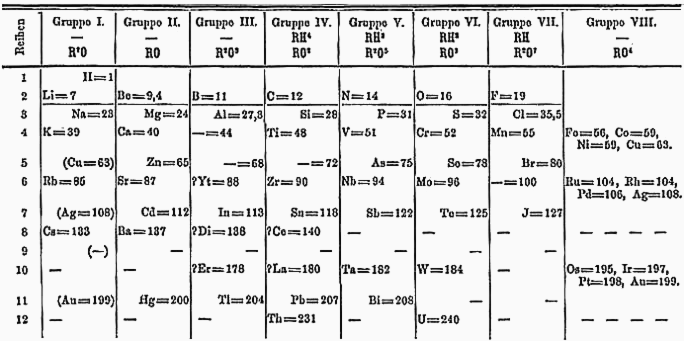
Mendelejevs periodiska system 1871. Image: The original uploader was Den fjättrade ankan at Swedish Wikipedia . · Public domain · Wikimedia Commons
Chemistry is the science of what things are made of and how substances change. It grew from ancient crafts — making metals, dyes, glass and medicines — and from alchemy, the old quest to turn common metals into gold.
The alchemists never made gold, but their furnaces and flasks taught real skills. In the 1700s chemistry became a true science, and its discoveries built the modern world of medicines, fertilisers and materials.
Key Facts
['Ancient roots', 'Metalworking, dyes and glass from about 3000 BCE']
['Alchemy', 'Practised in Egypt, China, the Islamic world and Europe']
['Father of modern chemistry', 'Antoine Lavoisier, 1700s']
['Oxygen', 'Identified in the 1770s']
['Periodic table', 'Dmitri Mendeleev, 1869']
['Radioactivity', 'Discovered in the 1890s — Becquerel, Marie and Pierre Curie']
Crafts and alchemists
Long before chemistry had a name, craftsmen smelted copper and iron, tanned leather, dyed cloth purple and made glass. Egyptian, Chinese, Indian and Greek thinkers wondered what matter was made of — earth, air, fire and water, said the Greeks.
Alchemists in Alexandria, Baghdad, China and Europe searched for the secret of turning lead into gold and for a medicine of eternal life. They failed at both — but invented distillation, acids, and careful laboratory methods on the way.
Chemistry becomes a science
In the 1700s, chemists weighed and measured everything. Antoine Lavoisier showed that burning and breathing use a gas he named oxygen, and that matter is never created or destroyed, only changed.
John Dalton proposed that all matter is built from atoms, and in 1869 Dmitri Mendeleev arranged the known elements into his periodic table — leaving gaps that correctly predicted elements not yet found.
Chemistry in everyday life
The 1800s and 1900s brought synthetic dyes, fertilisers that fed billions, plastics, petrol chemicals and life-saving medicines like penicillin, made at industrial scale.
Chemistry also left hard lessons — poisons, pollution and weapons — and today green chemistry works to make the science cleaner. Every soap bubble and loaf of bread still begins in the alchemist's old question: what is this made of?
Did You Know?
Mendeleev's periodic table predicted the existence and properties of undiscovered elements so accurately that when gallium was found in 1875, it matched his forecast almost exactly.