This article is written in English. Choose a language to open an automatic translation by Google Translate. Automatic translations can sometimes get historical names and dates wrong — for full accuracy, read the original English article.
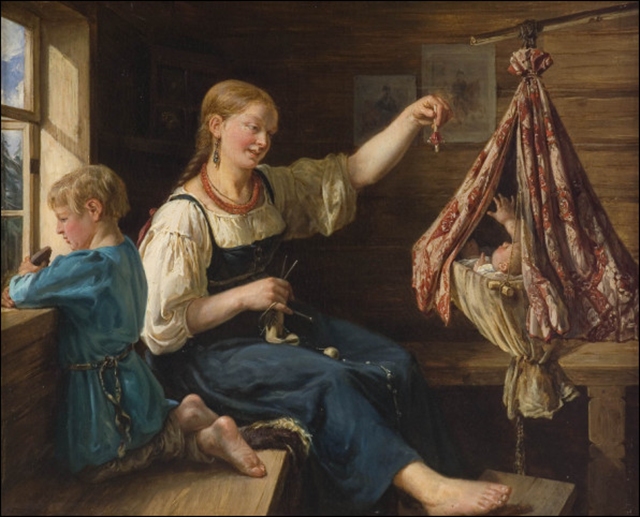
Soothing children's song. Image: François Nicholas Riss · Public domain · Wikimedia Commons
A lullaby is a soft song sung to help a baby sleep. It may be the oldest kind of music in the world — one lullaby written in Babylon about 4,000 years ago still survives on a clay tablet.
Every culture has lullabies. They sound gentle, but their words often carry history, prayers, warnings and a parent's deepest hopes.
Key Facts
['Oldest lullaby', 'A Babylonian lullaby on clay, about 4,000 years old']
["Word 'lullaby'", "In English from the Middle Ages — 'lulla' + 'by', sounds for rocking a baby"]
["Brahms' Lullaby", 'Johannes Brahms publishes his famous Wiegenlied in 1868']
['Rock-a-bye Baby', 'Printed in England in the 1700s; the falling cradle may recall babies rocked in trees or boats']
['Twinkle Twinkle', 'Its tune is a French folk melody from 1761, also used for the alphabet song']
['Hidden meanings', 'Many lullabies quietly mention war, poverty or lost parents']
Songs at the cradle
Rocking and humming need no instruments, so lullabies probably began with the first mothers and fathers. The Babylonian tablet lullaby gently warns the baby not to cry and wake the household gods — a tired parent's plea, 4,000 years old.
Lullabies follow the rocking rhythm of the cradle, slow and repeating. Sailors' wives sang of the sea, farming families of fields and animals, and enslaved mothers in America hid sorrow and hope inside their cradle songs.
Famous lullabies of the world
Germany gave the world Brahms' Lullaby, sung in dozens of languages. Japan's Edo lullaby tells of a young nursemaid far from home; the Filipino 'Sa Ugoy ng Duyan' rocks to the swing of a hammock; and 'All the Pretty Little Horses' carries an enslaved mother's promise to her child.
Some lullabies are surprisingly dark — falling cradles, wolves at the door, soldiers gone to war. Sung softly, they let parents speak fears aloud while the baby hears only love and rhythm.
Why lullabies still work
Modern science confirms what parents always knew: a familiar singing voice slows a baby's heartbeat and helps sleep come. Hospitals now use recorded parental lullabies for premature babies.
In a world of machines and screens, the lullaby remains unchanged technology: one voice, one child, one slow song — the same invention that worked in Babylon.
Did You Know?
Brahms' famous Lullaby was written for a friend's new baby — Brahms had once loved the mother, and he hid a melody from one of her favourite songs inside it.