This article is written in English. Choose a language to open an automatic translation by Google Translate. Automatic translations can sometimes get historical names and dates wrong — for full accuracy, read the original English article.
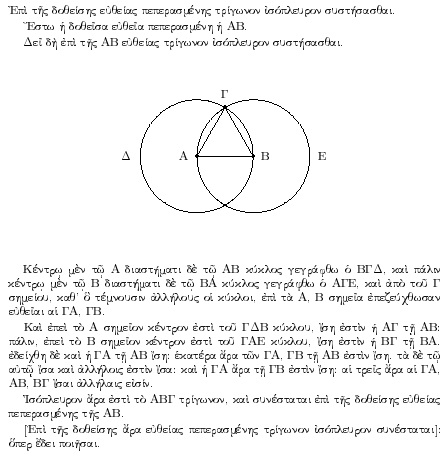
a proof from en:Euclid 's Elements (Book I, Proposition I) english translation available here: S:Page:The_Elements_of_Euclid_for_the_Use_of_Schools_and_Colleges_-_1872.djvu/31. Image: The original uploader was Bcrowell at English Wikipedia . · GPL · Wikimedia Commons
Mathematics is the study of numbers, shapes and patterns. It began with simple needs — counting sheep, measuring fields, tracking the stars — in the earliest farming societies.
From clay tablets in Babylon to the algebra of Baghdad and the calculus of Newton and Leibniz, mathematics grew by passing from culture to culture, each adding new ideas.
Key Facts
['Counting marks', 'Bones with tally marks, over 20,000 years old']
['Babylonian mathematics', 'Clay tablets with advanced tables, about 1800 BCE']
['Egyptian mathematics', 'Practical geometry for land and pyramids']
['Zero as a number', 'Developed in India by about the 600s CE']
['Algebra', "Named from al-Khwarizmi's book, about 820 CE"]
['Calculus', 'Newton and Leibniz, late 1600s']
Numbers on clay and papyrus
Farmers and tax collectors needed arithmetic, and surveyors needed geometry — the word itself means 'earth measuring'. Babylonian scribes solved problems we would call algebra and knew the rule of the right-angled triangle a thousand years before Pythagoras.
Egyptian scribes calculated areas, volumes and the slopes of pyramids. In China, counting rods and the book Nine Chapters taught practical mathematics to officials and engineers.
Proofs, zero and algebra
Greek thinkers such as Pythagoras and Euclid changed mathematics by demanding proof — not just answers, but reasons. Euclid's Elements taught geometry for over 2,000 years.
Indian mathematicians gave the world the numerals we use today, including zero as a true number, and negative numbers. Scholars in Baghdad, above all al-Khwarizmi, carried these ideas onward — his book gave us the word 'algebra', and his name gave us 'algorithm'.
Mathematics builds the modern world
In the 1600s, Newton and Leibniz created calculus, the mathematics of change, which made modern physics and engineering possible. Later centuries added statistics, probability and the logic behind computing.
Today mathematics hides inside bridges, medicines, weather forecasts, codes and phones. The tally marks on a Stone Age bone were the first step on a road that has never ended.
Did You Know?
The numerals the whole world uses today — 0, 1, 2, 3 — travelled from India through the Arab world to Europe, which is why Europeans long called them 'Arabic numerals'.