This article is written in English. Choose a language to open an automatic translation by Google Translate. Automatic translations can sometimes get historical names and dates wrong — for full accuracy, read the original English article.
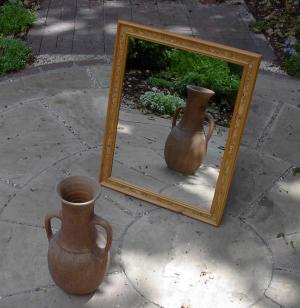
: A wall mirror, reflecting a vase. Image: Cgs · CC BY-SA 3.0 · Wikimedia Commons
Before mirrors, people saw their faces only in still water. The first mirrors were polished stones and metals — shiny pieces of volcanic glass in Anatolia about 8,000 years ago, and polished copper and bronze in Egypt and China.
A true, clear mirror of glass backed with metal arrived only about 500 years ago in Venice. It was so precious that a single mirror could cost more than a warship.
Key Facts
['First mirrors', 'Polished obsidian stone, Anatolia, about 6000 BCE']
['Ancient mirrors', 'Polished copper and bronze, in Egypt, Greece and China']
['Chinese bronze mirrors', 'Often decorated on the back with symbols and animals']
['Clear glass mirrors', 'Venice, early 1500s — glass backed with tin and mercury']
['Cheap mirrors begin', "1835 — Justus von Liebig's silvering method"]
['Today', 'Mirrors serve telescopes, lasers, cars and bathrooms alike']
Faces in stone and bronze
The oldest mirrors, found in Anatolia, were made of obsidian — black volcanic glass polished until it threw back a dim reflection. In Egypt, mirrors of polished copper and bronze were shaped like the sun disc and buried with their owners.
Chinese craftsmen cast round bronze mirrors with lucky designs on the back, and polished the front to a shine. All early mirrors gave a dark, wavy image — but they were magic enough to appear in myths, like the Greek story of Narcissus, who fell in love with his own reflection.
Venice and the perfect mirror
Glassmakers on the Venetian island of Murano learned to make perfectly clear, flat glass and coat its back with a shining mixture of tin and mercury. For the first time, people saw themselves truly — bright and sharp.
Venice guarded the secret fiercely, but French agents lured mirror-makers away, and France built the famous Hall of Mirrors at Versailles with 357 mirrors to show it had mastered the craft. Mirrors were still ruinously expensive.
Mirrors for everyone
In 1835, the German chemist Justus von Liebig found how to coat glass with a thin layer of real silver. Mirrors became cheap, clear and safe to make, and soon hung in every home.
The same silvered glass, made ever more perfect, now gathers starlight in giant telescopes and focuses the sun's power in solar plants. The mirror began as a king's luxury and became one of science's greatest tools.
Did You Know?
A fine Venetian mirror in the 1600s could cost more than a fully armed warship — nobles sold land and jewels to buy one.