This article is written in English. Choose a language to open an automatic translation by Google Translate. Automatic translations can sometimes get historical names and dates wrong — for full accuracy, read the original English article.
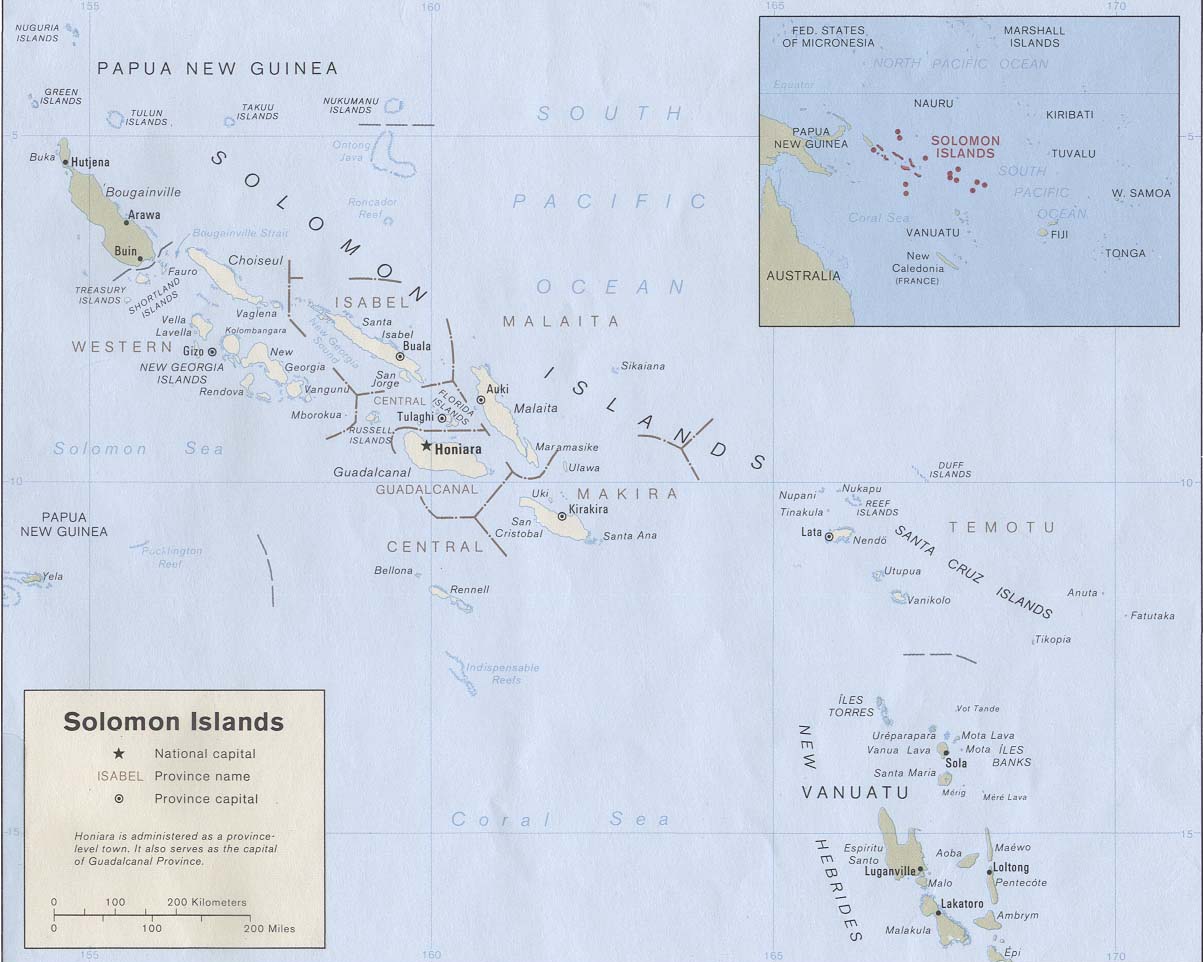
Solomon Islands 1989. Image: U.S. Central Intelligence Agency · Public domain · Wikimedia Commons
The Solomon Islands are a chain of volcanic islands in the South Pacific, east of Papua New Guinea. People have lived there for at least 30,000 years — among the longest-settled places in the Pacific.
The islands saw one of the Second World War's fiercest battles, at Guadalcanal, and became an independent nation in 1978.
Key Facts
['Capital', 'Honiara, on Guadalcanal']
['First settled', 'At least 30,000 years ago in the northern islands']
['First European', 'Alvaro de Mendana, 1568, who named the islands']
['British protectorate', 'From 1893']
['Famous battle', 'Guadalcanal, 1942–43 — a turning point of the Pacific War']
['Independence', '7 July 1978']
Ancient islands of the Pacific
The northern Solomon Islands were settled at least 30,000 years ago, when sea levels were lower. Later, about 3,000 years ago, the Lapita seafarers brought pottery, farming and new peoples to the rest of the chain.
Island societies grew around chiefs and big-men, shell money and feasts. In 1568 the Spanish explorer Alvaro de Mendana reached the islands and, hoping they were the source of King Solomon's gold, named them the Solomon Islands — then the outside world mostly lost track of them for 200 years.
Blackbirding, Britain and war
In the late 1800s, recruiters — often by force or trickery, in the practice called blackbirding — took tens of thousands of Solomon Islanders to work on plantations in Queensland and Fiji. In 1893 Britain declared a protectorate over the islands.
In 1942 Japan seized the islands and built an airfield on Guadalcanal. American forces landed that August, and six months of savage land, sea and air battles followed. The Allied victory at Guadalcanal was a turning point of the Pacific War; the capital Honiara grew from the wartime base.
Independence and the Tensions
The Solomons became independent on 7 July 1978, keeping the British monarch as head of state, represented by a governor-general.
From 1998 to 2003, conflict between groups from Guadalcanal and Malaita — called the Tensions — brought violence and economic collapse, until an Australian-led Pacific mission (RAMSI) restored peace. The islands today face big questions about logging, mining and rising seas.
Did You Know?
American president John F. Kennedy survived the sinking of his boat PT-109 in the Solomons in 1943 — rescued with the help of Solomon Islander scouts, whose names are still honoured.