This article is written in English. Choose a language to open an automatic translation by Google Translate. Automatic translations can sometimes get historical names and dates wrong — for full accuracy, read the original English article.
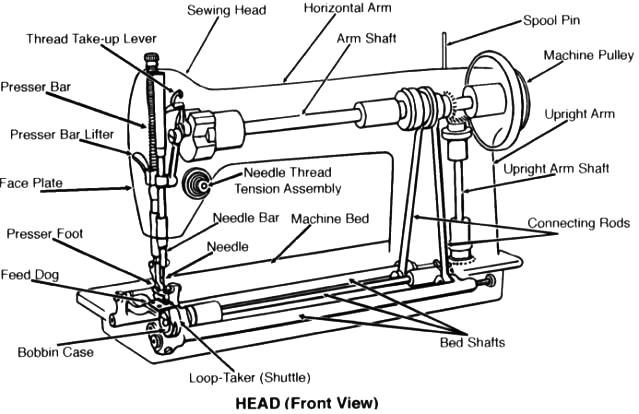
A diagram of a modern sewing machine. Image: Unknown author Unknown author · Public domain · Wikimedia Commons
Every stitch in clothing was once sewn by hand. A single shirt could take many hours of needlework — and tailors and seamstresses spent their lives at it.
The sewing machine, perfected in the 1840s and 1850s, sewed ten times faster than the quickest hand. It changed factories, shops and homes all at once.
Key Facts
['First practical machine', '1830 — Barthélemy Thimonnier, France (chain stitch)']
['Key patent', "1846 — Elias Howe's lockstitch machine"]
['The famous name', "Isaac Singer's machine, 1851 — and his hire-purchase selling plan"]
['Speed', "A machine could sew about 900 stitches a minute against a hand-sewer's 40"]
['Factory effect', 'Ready-made clothing became cheap for the first time']
['Home effect', 'Millions of women sewed family clothes at home']
The race to mechanise the needle
Many inventors chased the sewing machine. In 1830 the French tailor Barthélemy Thimonnier built machines that sewed uniforms for the army — until frightened tailors, fearing for their jobs, smashed his workshop.
In America, Elias Howe solved the key puzzle in 1846: a needle with its eye near the point, and a second thread from below, making a strong 'lockstitch' — still the stitch most machines use.
Singer makes it sing
Isaac Singer improved the design — a straight needle moving up and down, a presser foot, and a treadle — and, just as importantly, sold machines in monthly instalments so ordinary families could afford one.
Singer's company became one of the world's first giant international businesses, with factories from Scotland to Russia. Patent battles ended in a shared pool that let the industry boom.
Needlework transformed
Clothing factories with rows of machines made ready-to-wear clothes cheap; uniforms for millions of soldiers became possible; and home sewing machines let families make and mend their own clothes in hours, not days.
Electric motors replaced treadles in the 1900s, and computerised machines followed. But the heart of the machine is still Howe's lockstitch, humming away nearly 180 years on.
Did You Know?
Isaac Singer's machines were sold by travelling salespeople who demonstrated them at fairs — and his instalment plan is often called the first modern hire-purchase scheme for ordinary families.