This article is written in English. Choose a language to open an automatic translation by Google Translate. Automatic translations can sometimes get historical names and dates wrong — for full accuracy, read the original English article.
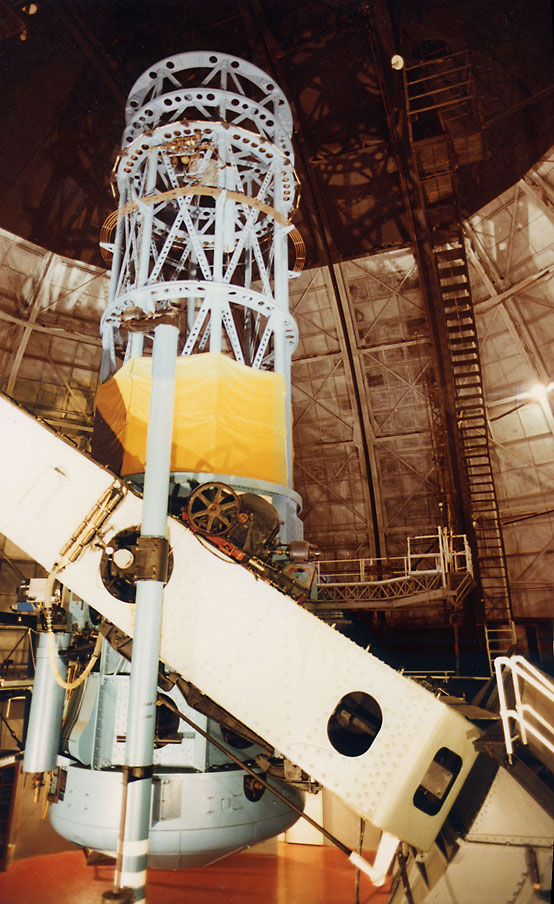
Instrument that makes distant objects appear magnified. Image: Andrew Dunn · CC BY-SA 2.0 · Wikimedia Commons
The telescope shrank the universe into view. Before it, people could see only a few thousand stars with the naked eye; after it, they found new planets, moons around other worlds, and galaxies beyond counting.
It appeared in the Netherlands in 1608 as a simple spyglass — and within a year Galileo had turned it to the sky and changed our place in the universe forever.
Key Facts
['First telescope', '1608 — Hans Lippershey applied for a patent in the Netherlands']
["Galileo's observations", '1609–10 — mountains on the Moon, moons of Jupiter']
["Newton's design", '1668 — the reflecting telescope, using mirrors']
['Largest telescopes', 'Giant mirror telescopes on high mountains in Chile and Hawaii']
['Hubble Space Telescope', 'Launched 1990 — famous deep-space photographs']
['James Webb Telescope', 'Launched 2021 — sees the earliest galaxies']
A spyglass points upward
In 1608 the Dutch lens-maker Hans Lippershey tried to patent a tube that made distant things seem near. News of the 'spyglass' raced across Europe — armies wanted it for war.
Hearing of it in 1609, Galileo Galilei built his own, stronger versions. Unlike everyone else, he pointed his at the night sky — and saw what no human had ever seen.
Galileo's new universe
Galileo found mountains on the Moon, countless new stars, and four moons circling Jupiter — proof that not everything orbits Earth. He saw the phases of Venus, which fitted the idea that Earth moves around the Sun.
His book The Starry Messenger (1610) made him famous and shook the old picture of the heavens. Isaac Newton later improved the telescope itself, using a mirror instead of lenses to gather light.
Eyes on the deep sky
Telescopes grew: William Herschel discovered Uranus in 1781 with one he built himself, and great observatories rose on clear mountains. Photography, then digital sensors, let telescopes gather light for hours.
In 1990 the Hubble Space Telescope began working above Earth's blurry air, and in 2021 the James Webb Telescope followed — looking back almost to the first galaxies that ever shone.
Did You Know?
Galileo did not invent the telescope — but he was the first to publish what it revealed in the sky. His Jupiter moons are still called the Galilean moons.