This article is written in English. Choose a language to open an automatic translation by Google Translate. Automatic translations can sometimes get historical names and dates wrong — for full accuracy, read the original English article.
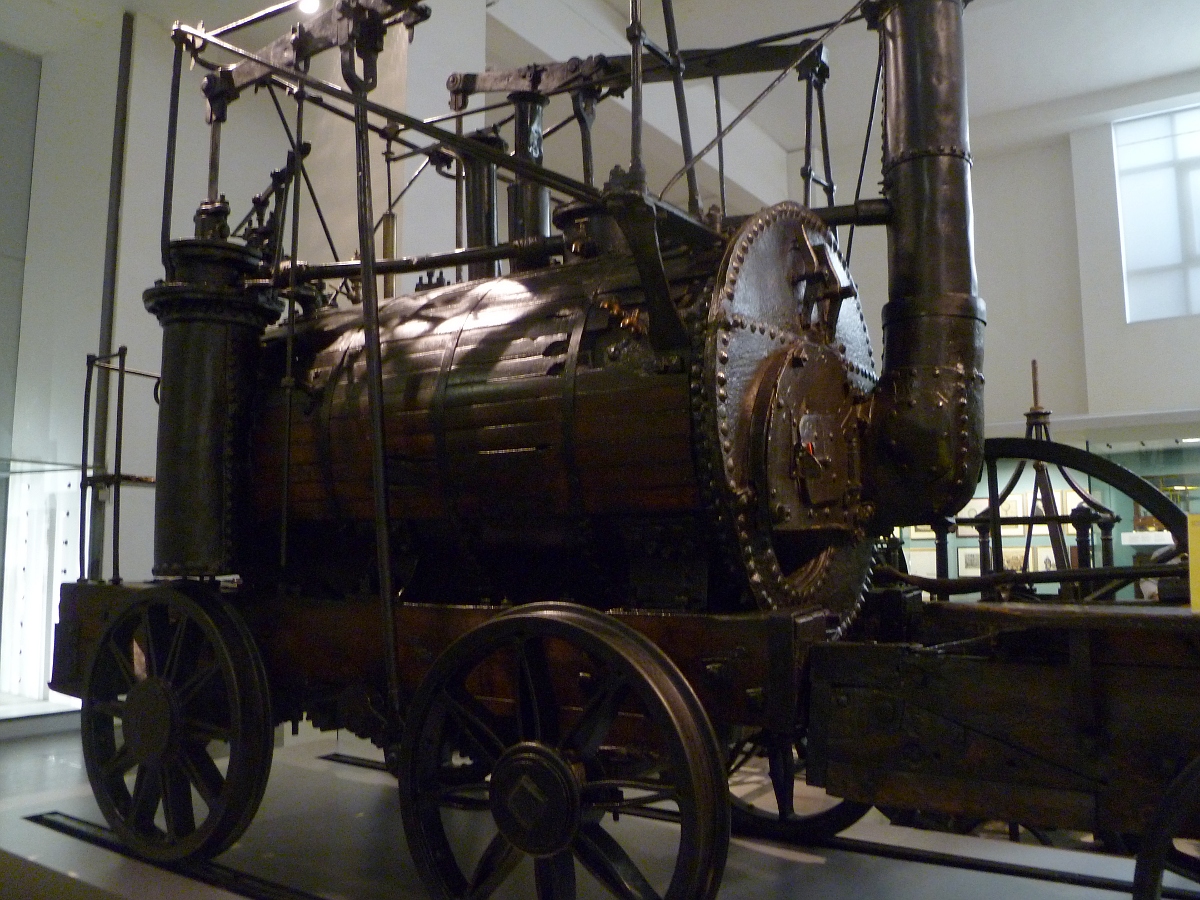
Side view of "Puffing Billy", the oldest surviving steam locomotive in the UK. Taken at the Science Museum, South Kensington, London, UK. Image: Arkady Rose · CC BY-SA 3.0 · Wikimedia Commons
Trains are vehicles that run on rails, guided by their tracks so they can be long, heavy and fast. Wagons on wooden and iron rails were used in mines for centuries before the steam locomotive arrived in 1804.
The railway age of the 1800s shrank the world: journeys of days became hours, fresh food reached cities, and standard time was invented because timetables demanded it.
Key Facts
['First steam locomotive', '1804 — Richard Trevithick, in Wales']
['First public steam railway', '1825 — Stockton and Darlington, England']
['Rocket locomotive', "1829 — George Stephenson's famous winner"]
['Fastest trains today', 'About 320 km/h in service; test trains far faster']
['Longest rail network', 'The United States; China leads in high-speed lines']
From mine wagons to steam engines
Miners had pushed wagons along rails since the 1500s — rails made heavy loads easy to move. When steam engines became small and strong, putting one on wheels was the obvious next step.
In 1804, Richard Trevithick's locomotive hauled iron along a Welsh track, and in 1825 the Stockton and Darlington Railway carried passengers behind Stephenson's engine. Railways suddenly were for everybody.
The railway age
Railway lines spread like vines across Britain, Europe, America, India and beyond. Towns grew around stations, seaside holidays were invented, and mail and newspapers travelled at unheard-of speed.
Because every town once kept its own local time, timetables forced countries to adopt standard time zones — the railway literally organised the clock. Steam ruled for a century, then diesel and electric power took over.
Trains in the modern world
Japan's Shinkansen bullet train of 1964 began the age of high-speed rail, later joined by France's TGV and China's vast high-speed network. Trains glide between city centres at 300 km/h and more.
Underground metros carry millions through great cities every day, and freight trains haul the goods of the world. The mine wagon's descendants remain the backbone of land travel.
Did You Know?
Britain's railways ran on so many different local times that in 1847 the railways adopted Greenwich Mean Time across the network — the first step toward standard time for everyone.