This article is written in English. Choose a language to open an automatic translation by Google Translate. Automatic translations can sometimes get historical names and dates wrong — for full accuracy, read the original English article.
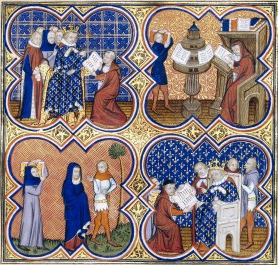
Transfer of the meaning of something in one language into another. Image: Unknown author Unknown author · Public domain · Wikimedia Commons
Translation — carrying words from one language into another — is one of the oldest jobs in the world. As soon as peoples who spoke differently met to trade or rule empires, they needed translators.
Translated books have moved ideas across the whole planet: Greek science reached Europe through Arabic, and the Bible became the most translated book in history. Today computers translate billions of words every day.
Key Facts
['Ancient start', 'Translators served empires in Egypt and Mesopotamia over 4,000 years ago']
['Famous early work', 'The Septuagint — the Hebrew Bible translated into Greek, about 200s BCE']
['Baghdad', 'The House of Wisdom translated Greek learning into Arabic in the 800s–900s']
['Most translated book', 'The Bible — in full or in part in over 3,000 languages']
['King James Bible', 'The famous English translation of 1611']
['Machine translation', 'Began in the 1950s; free online translators arrived in the 2000s']
Translators of the ancient world
Great empires ruled many languages at once, so royal translators were essential. The Rosetta Stone itself is a translation: one Egyptian decree written in three scripts for different readers.
Around the 200s BCE, Jewish scholars in Egypt translated their scriptures into Greek — the Septuagint — one of the most influential translations ever made.
Translation moves knowledge
In Baghdad's House of Wisdom, teams translated Greek, Persian and Indian books into Arabic, preserving and growing the world's science. Centuries later, translators in Spain carried that learning from Arabic into Latin for Europe.
Religion drove much translation: Buddhist texts travelled from India into Chinese, and Christian missionaries translated the Bible into hundreds of languages.
The machine age
In 1954 an early computer publicly translated a few Russian sentences into English, and people dreamed machines would soon do it all. Real progress took decades of work.
Today, translation software handles billions of words daily and travellers speak through their phones. Human translators still do the hardest work — literature, law and poetry — where meaning hides between the words.
Did You Know?
The word 'translation' comes from Latin words meaning 'carried across' — a perfect picture of the job: carrying meaning across the river between two languages.