Horses in History
This article is written in English. Choose a language to open an automatic translation by Google Translate. Automatic translations can sometimes get historical names and dates wrong — for full accuracy, read the original English article.
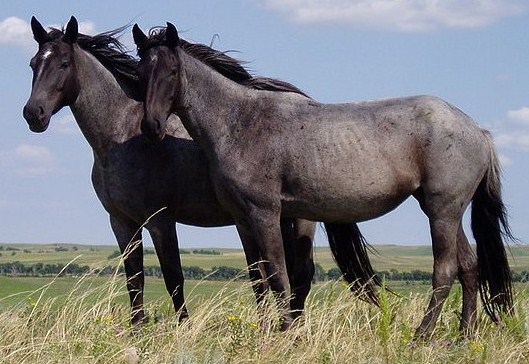
Image: Nokota_Horses.jpg : François Marchal derivative work: Dana boomer ( talk ) · CC BY-SA 3.0 · Wikimedia Commons
No animal has carried human history further than the horse. First hunted for food, horses were tamed on the grasslands of Central Asia about 5,500 years ago — and from that moment, they pulled our ploughs, carried our soldiers, delivered our messages and shrank the size of the world.
For thousands of years the horse was humanity's fastest transport and strongest partner. Engines replaced it only a century ago, yet its hoofprints are on everything from our languages to the shape of our nations.
Key Facts
- ['Domesticated', 'About 3500 BCE, on the Eurasian steppe']
- ['First uses', 'Milk, meat, then riding and chariots']
- ['War chariot age', 'From about 2000 BCE']
- ['Famous partnership', 'Alexander and his horse Bucephalus']
- ['Changed warfare', 'Stirrups, knights and cavalry']
- ['Replaced by', 'Cars, tractors and tanks, 1900s']
From prey to partner
Wild horses roamed the Ice Age world, and early humans hunted them — cave paintings show herds of small, sturdy horses. Then, on the steppes of what is now Kazakhstan, the Botai people tamed them around 3500 BCE, keeping them first for milk and meat, and soon discovering the greater gift: riding.
A human on horseback could travel five times faster than on foot, herd more animals, and cross the vast grasslands. Wheeled carts and then war chariots followed — by 2000 BCE chariot armies were deciding the fate of Egypt, the Hittites and Shang China alike.
Horses build empires
Cavalry became the striking arm of ancient empires. Alexander the Great rode Bucephalus through a decade of conquest; the Persians, Romans and Chinese all built mounted forces; and China's hunger for the 'heavenly horses' of Central Asia helped open the Silk Road. The stirrup, spreading from Asia in the early Middle Ages, let a rider fight from the saddle with a couched lance — and made the armoured knight possible.
On the steppe, horse peoples — Scythians, Huns, Turks and above all the Mongols — turned riding into empire. Mongol horse-archers, with remounts and stirrups, conquered the largest land empire in history in the 1200s.
The horse in everyday life
War is only half the story. Horses ploughed fields, hauled coal and canal boats, pulled stagecoaches, omnibuses, fire engines and ploughs, and carried the mail — from Persia's royal messengers to America's Pony Express of 1860–61. Cities ran on horses: in 1900, London and New York each depended on tens of thousands, and their manure and carcasses were among the great urban problems of the age.
Horsepower moved the goods of the early Industrial Revolution too, in mills and mines — which is why James Watt measured his steam engine in 'horsepower', a unit we still use.
The age of engines — and the horse today
Between 1900 and 1950, tractors, cars, trucks and tanks did what no enemy could: they made the horse unnecessary. Cavalry charges faded in the First World War, and farm horses vanished within a generation in most rich countries — one of the fastest changes in the human–animal story.
Yet the horse never left. It thrives in sport, racing, police work, therapy and leisure — loved now not for its labour but for itself. After five thousand years as our engine, the horse has become our companion.
The word 'horsepower' was a marketing trick: James Watt calculated how much work a mill horse could do so he could tell customers how many horses each of his steam engines would replace.
Related Topics
Sources
Reviewed: 24 November 2026
Read this article in the interactive Pastloom reader →