This article is written in English. Choose a language to open an automatic translation by Google Translate. Automatic translations can sometimes get historical names and dates wrong — for full accuracy, read the original English article.
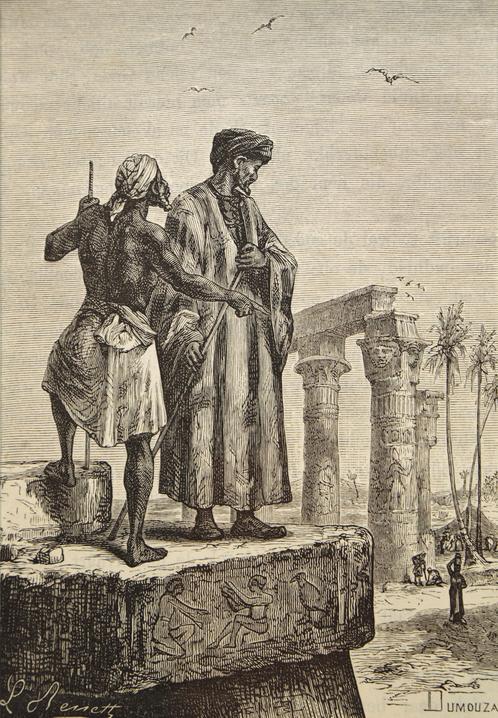
An illustration from Jules Verne 's book "Découverte de la terre" ("Discovery of the Earth") drawn by Léon Benett. Ibn Battuta (1304-68/69) was a Maghrebi Berber scholar and traveller. Image: Léon Benett · Public domain · Wikimedia Commons
Ibn Battuta was a Moroccan traveller who may be the greatest traveller of the age before aeroplanes. Starting with a pilgrimage to Mecca in 1325, he kept travelling for nearly thirty years.
He crossed Africa, the Middle East, India and China — a journey of about 117,000 kilometres, far further than Marco Polo — and his book, the Rihla, is a window into the whole Islamic world of the 1300s.
Key Facts
['Born', '24 February 1304, in Tangier, Morocco']
['Set out', '1325, aged twenty-one']
['Years travelling', 'About 29 years']
['Distance', 'About 117,000 kilometres']
['Jobs on the road', 'Judge (qadi) in India and the Maldives']
['His book', "The Rihla — 'The Journey'"]
A pilgrimage that never quite ended
Ibn Battuta left Tangier in 1325 intending only to perform the Hajj pilgrimage to Mecca. The journey fired his curiosity, and instead of going home, he travelled on — to Iraq, Persia and East Africa.
He later crossed Arabia again, sailed to India, and spent years there as a judge in the service of the Sultan of Delhi, before travelling onward to the Maldives, Sri Lanka and China.
Across Africa to Timbuktu
After finally returning to Morocco in 1349, he set out twice more: to Muslim Spain, and then across the Sahara Desert to the Empire of Mali.
There he visited the famous trading city of Timbuktu and described the gold-rich courts of West Africa — lands almost unknown to the rest of the world.
The book of wonders
Back home in Fez, Ibn Battuta dictated his memories to a scholar, Ibn Juzayy, who shaped them into the Rihla. For centuries the book was little known outside Morocco.
Today historians treasure it as a first-hand record of life across an enormous world — its cities, customs, foods and rulers — seen through the eyes of one tireless, curious traveller.
Did You Know?
Ibn Battuta travelled roughly three times the distance Marco Polo did — and visited lands equivalent to about 40 modern countries, mostly on foot, by camel, or by wooden sailing ship.