The Lisbon Earthquake of 1755
This article is written in English. Choose a language to open an automatic translation by Google Translate. Automatic translations can sometimes get historical names and dates wrong — for full accuracy, read the original English article.
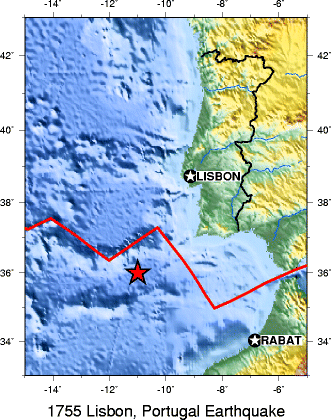
Image: USGS · Public domain · Wikimedia Commons
On the morning of 1 November 1755 — All Saints' Day, a major religious holiday — a gigantic earthquake struck Lisbon, the capital of Portugal. Churches full of worshippers collapsed, and then a tsunami and fires finished the destruction.
Tens of thousands of people died, and one of Europe's richest cities was left in ruins. The disaster changed how Europeans thought about nature and religion, and it led to the birth of the modern science of earthquakes.
Key Facts
- ['Date', '1 November 1755, at about 9:40 in the morning']
- ['Place', "Lisbon, Portugal; the quake's centre was in the Atlantic Ocean"]
- ['Strength', 'Estimated at about magnitude 8.5']
- ['Died', 'Tens of thousands — estimates range from about 10,000 to 50,000']
- ['Triple disaster', 'Earthquake, then tsunami, then fires lasting days']
- ['Rebuilt by', "The Marquis of Pombal, the king's chief minister"]
All Saints' Day horror
The first shock lasted several minutes and was felt across Europe and North Africa. In Lisbon, palaces, churches and the great opera house crashed down, and a huge crack was said to have opened in the city centre.
Many survivors ran to the open ground by the river and harbour for safety. About forty minutes later, they watched in horror as the sea first withdrew and then returned as a giant wave that smashed ships and flooded the lower city.
Fire and questions
Candles burning in churches for the holiday, and cooking fires in ruined homes, started blazes that burned for five days. When it was over, about 85 percent of Lisbon's buildings were destroyed or damaged.
Across Europe, people asked painful questions. How could such a disaster strike a devout city on a holy day? The writer Voltaire attacked easy answers in his famous book Candide, and philosophers debated the problem for years.
Pombal builds a new Lisbon
The king's minister, the Marquis of Pombal, acted fast and firmly. Asked what was to be done, he is said to have replied: bury the dead and heal the living. Bodies were buried at sea to prevent disease, and food was organised for survivors.
Pombal rebuilt the city centre on a neat grid of wide streets, using a clever wooden cage framework inside the buildings — one of the world's first earthquake-resistant designs. He also sent questionnaires to every parish about the shaking, an early work of earthquake science.
The Lisbon earthquake was so powerful that it made church bells ring by themselves in distant parts of Europe and caused lakes in Scotland to slosh back and forth.
Related Topics
Sources
Reviewed: 22 November 2026
Read this article in the interactive Pastloom reader →