This article is written in English. Choose a language to open an automatic translation by Google Translate. Automatic translations can sometimes get historical names and dates wrong — for full accuracy, read the original English article.
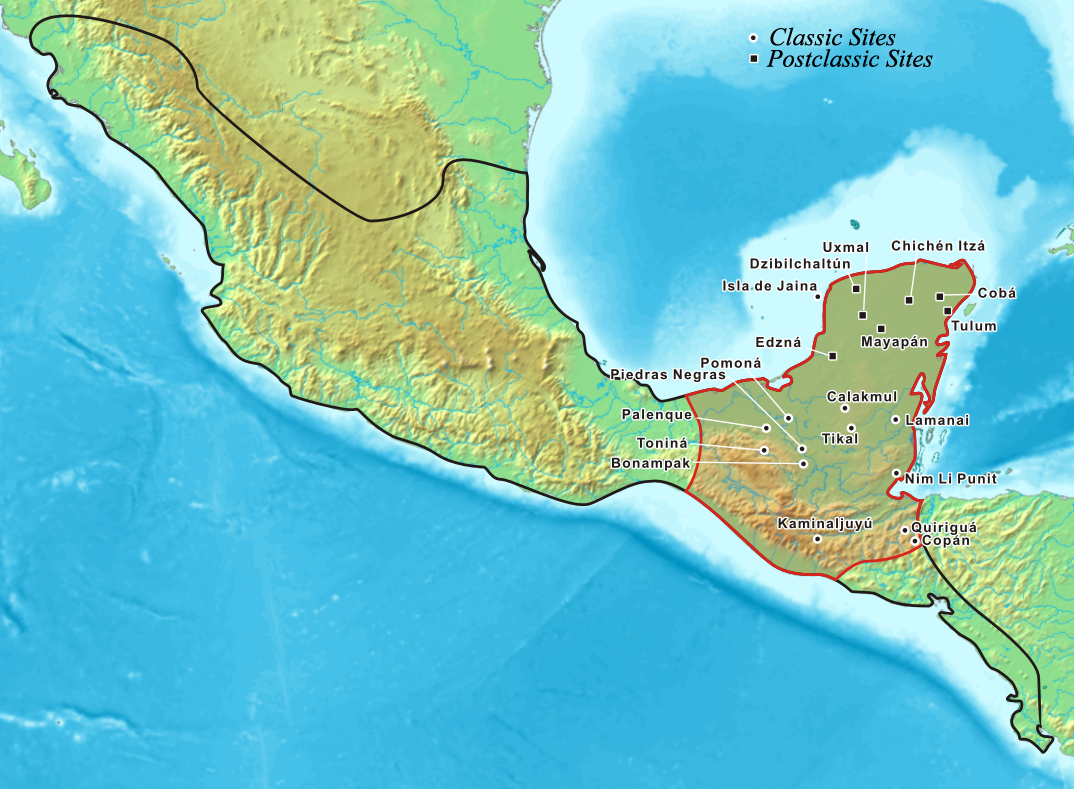
Mesoamerican civilization (c. 2000 BC – 1697 AD). Image: Kmusser · CC BY-SA 3.0 · Wikimedia Commons
The Maya civilisation grew in the rainforests of Mexico and Central America. The Maya built great stone cities with pyramids, palaces and ball courts — without metal tools or wheeled carts.
They were expert astronomers and mathematicians. They created an accurate calendar, a full writing system, and used the number zero long before it reached Europe.
Key Facts
['Where', 'Mexico and Central America']
['Flourished', 'About 250–900 CE (Classic period)']
['Today', 'Millions of Maya people still live in the region']
Cities in the jungle
At its height, the Maya world held dozens of city-states, each with its own king. Cities like Tikal had huge pyramids and plazas where tens of thousands of people lived.
Farmers grew maize, beans and squash in the forest. Kings held ceremonies on pyramid tops, and a ball game with a rubber ball was played in stone courts.
Stars, calendars and writing
Maya priests watched the sun, moon and planets with great care. Their calendars could predict eclipses and the movements of Venus.
Maya scribes wrote books and carved texts in glyphs on stone monuments. They also used a dot-and-bar number system that included zero — one of the first in the world.
What happened to the Maya
Between about 800 and 900 CE, many southern Maya cities were abandoned. Drought, war and over-farming may all have played a part.
But the Maya did not disappear. Northern cities kept going, and today millions of Maya people still speak Maya languages and keep many old traditions.
Did You Know?
The Maya used the number zero in their mathematics — something European mathematics did not have until centuries later.