The Mughal Empire
This article is written in English. Choose a language to open an automatic translation by Google Translate. Automatic translations can sometimes get historical names and dates wrong — for full accuracy, read the original English article.
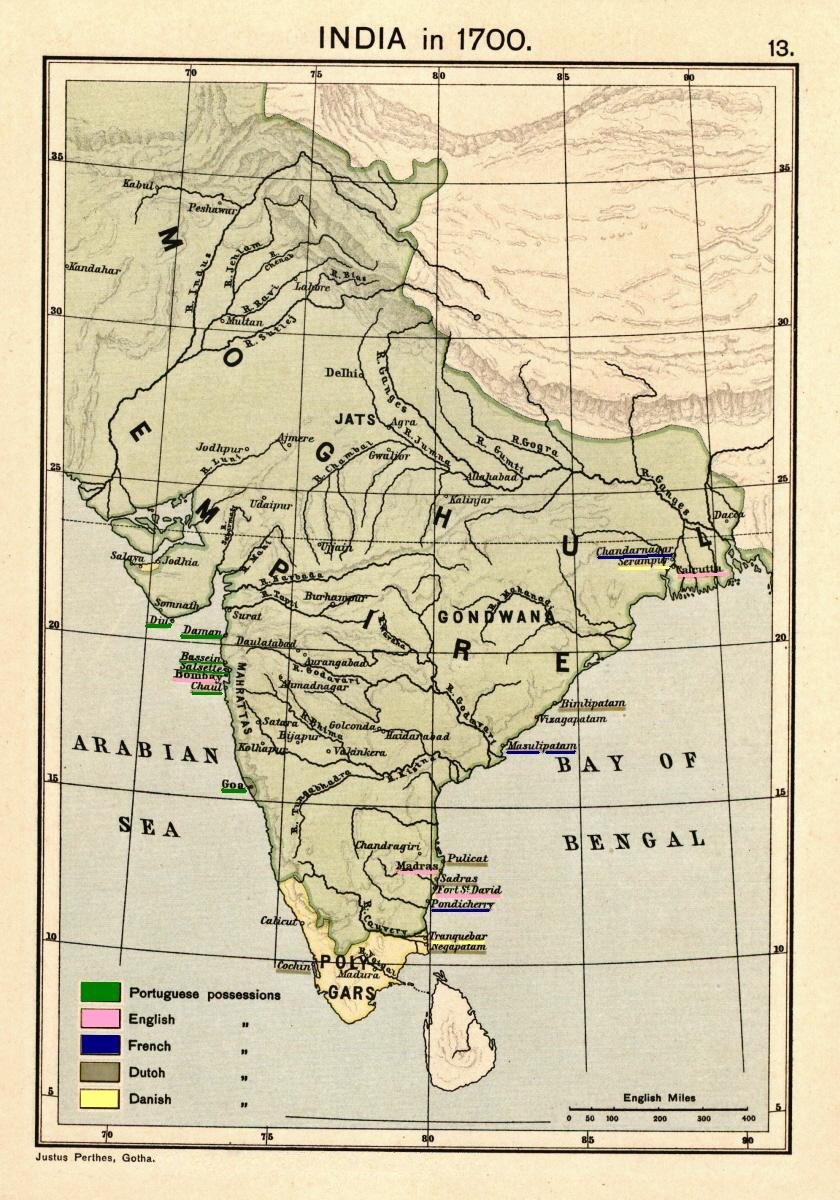
Image: Justus Perthes, Gotha./Charles Joppen · PD-US · Wikimedia Commons
The Mughal Empire ruled most of India for more than three hundred years, from 1526 to 1857. At its height under emperors like Akbar and Shah Jahan, it was one of the richest and most cultured states on Earth — home to perhaps a quarter of the world's economy.
The Mughals gave India the Taj Mahal, the Red Fort and a golden age of art and architecture. Their slow decline opened the door first to regional powers, then to British rule.
Key Facts
- ['Ruled', '1526–1857 (in power until about 1707)']
- ['Founder', 'Babur']
- ['Greatest emperors', 'Akbar, Shah Jahan, Aurangzeb']
- ['Capital', 'Agra, later Delhi (Shahjahanabad)']
- ['Famous monuments', "Taj Mahal, Red Fort, Humayun's Tomb"]
- ['Share of world economy', 'About a quarter of world GDP around 1700']
Babur the Tiger
The Mughals began with Zahir-ud-din Babur — a descendant of both Timur and Genghis Khan, a poet-prince who had lost his small Central Asian kingdom and marched into India looking for a new one. In 1526, at Panipat, his small army's guns and cavalry destroyed the Delhi Sultanate's host; in 1527 he beat the Rajput confederacy at Khanwa. The Mughal Empire had begun.
Babur died in 1530, leaving his son Humayun an empire he promptly lost to the Afghan Sher Shah — and regained only in 1555, months before his own death. The empire's true founder was Humayun's son.
Akbar the Great
Akbar came to the throne in 1556 at thirteen and ruled for 49 years. He conquered most of northern and central India, then governed brilliantly: a centralised administration, a land-revenue system assessed on measured fields, and high office open to talent — including Hindus, whom he courted with marriages and appointments.
A Muslim ruling a mostly Hindu land, Akbar abolished the tax on non-Muslims, debated all religions in his hall of worship, and preached sulh-i-kul — 'peace with all'. His court at Fatehpur Sikri and Agra drew painters, poets and musicians from across Asia. Under Akbar and his successors Jahangir and Shah Jahan, Mughal India became one of the richest states on Earth.
Shah Jahan and the age of marble
Shah Jahan (reigned 1628–58) turned imperial wealth into beauty: the Taj Mahal at Agra, built as a tomb for his beloved wife Mumtaz Mahal; the Red Fort and Jama Masjid of his new capital, Shahjahanabad (Old Delhi); and the jewel-like Peacock Throne. Mughal painting, gardens and architecture reached their peak.
But splendour had a price, and succession was a blood sport: Mughal princes fought for the throne as a rule — 'throne or coffin'. Shah Jahan's sons warred while he still lived; Aurangzeb won, imprisoned his father in Agra Fort within sight of the Taj, and took the throne in 1658.
Aurangzeb, decline and the long end
Aurangzeb (reigned 1658–1707) expanded the empire to its greatest size — nearly all of India — but ruled more strictly: he restored the tax on non-Muslims, and spent 25 years fighting the Marathas in the Deccan, draining the treasury. After his death, weak emperors, invading Persians and Afghans, and rising powers — Marathas, Sikhs, and the British East India Company — shrank the empire to a shadow.
The end came in 1857: after the great rebellion against the British, the last emperor, Bahadur Shah Zafar — a poet, not a ruler — was exiled to Burma, and the British Crown took India. But the Mughals left the subcontinent its most famous buildings, its Mughlai cuisine, miniature painting, and the memory of an age when India held about a quarter of the world's economy.
The Taj Mahal took about 20 years and some 20,000 workers to build. Legend says its dome's finial points to heaven; its white marble changes colour with the light — pink at dawn, gold by moonlight.
Related Topics
Sources
Reviewed: 24 November 2026
Read this article in the interactive Pastloom reader →