This article is written in English. Choose a language to open an automatic translation by Google Translate. Automatic translations can sometimes get historical names and dates wrong — for full accuracy, read the original English article.
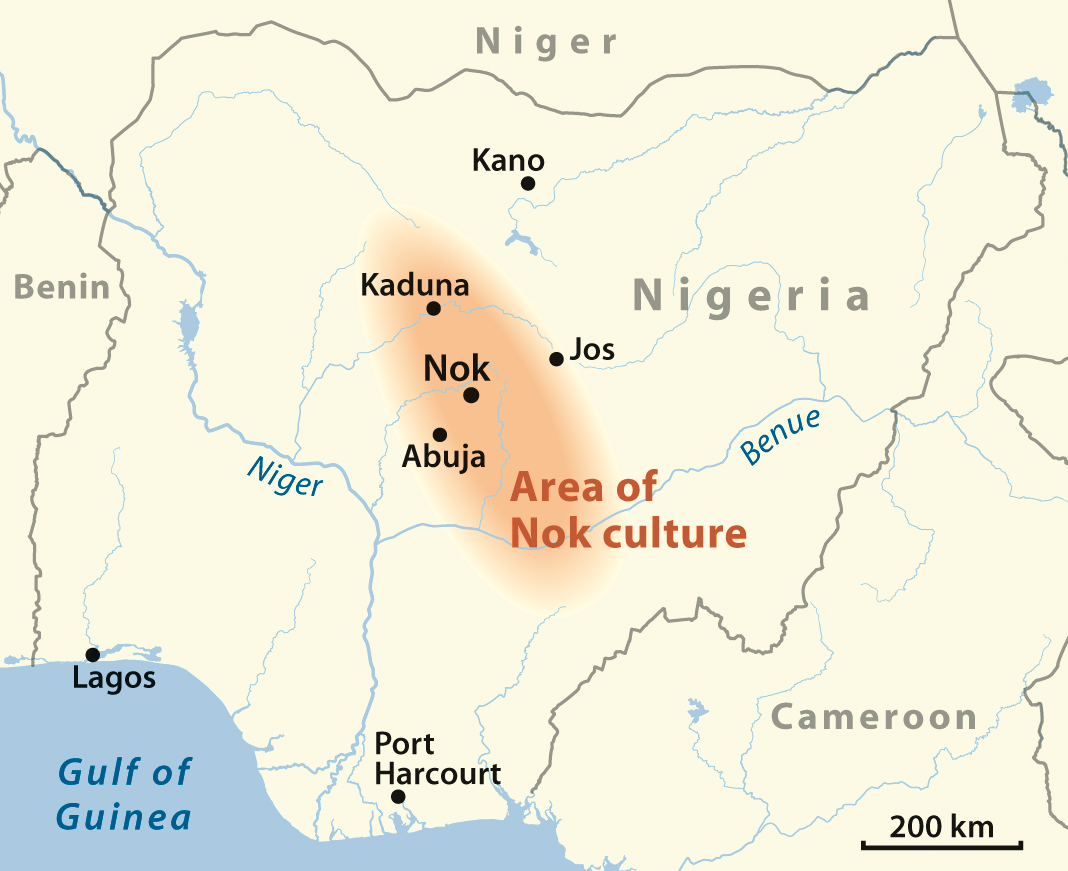
Area of the Nok culture , English version. Image: NordNordWest · CC BY-SA 3.0 · Wikimedia Commons
The Nok Culture was one of the earliest known cultures of West Africa. It flourished in what is now central Nigeria from about 900 BCE to about 200 CE — nearly 3,000 years ago.
The Nok people are famous for two things: their beautiful terracotta (baked clay) sculptures of human heads, and some of the earliest iron-working in Africa south of the Sahara.
Key Facts
['Where', 'Central Nigeria, around the Jos Plateau']
['Flourished', 'About 900 BCE – 200 CE']
['Named after', 'The village of Nok, where sculptures were first found']
['Famous for', 'Terracotta heads and figures']
['Also known for', 'Early iron smelting furnaces']
['Art style', 'Striking heads with elaborate hairstyles']
Heads of clay
In the 1940s, tin miners near the village of Nok began unearthing remarkable baked-clay heads — men and women with detailed hairstyles, jewellery and calm, powerful faces.
Archaeologists realised these were the work of a whole culture, spread over a large area of Nigeria. The sculptures are among the oldest figurative art in sub-Saharan Africa.
Masters of iron
The Nok were also pioneers of iron. Their furnaces — among the earliest in West Africa — smelted iron for tools and weapons centuries before many other regions.
Iron axes and hoes helped Nok farmers clear land and grow more food, supporting larger settlements. This technology later spread across Africa and changed farming and warfare everywhere.
A mystery that faded
Around 200 CE, the Nok culture slowly disappeared — perhaps because of disease, drought or overuse of wood for their furnaces. No writing survives, so we do not even know what the Nok people called themselves.
Yet their art and iron-working shaped the cultures that followed in Nigeria, and Nok heads are now national treasures, displayed in museums and printed on Nigerian stamps.
Did You Know?
Nok sculptures were dated using the clay itself — a method called thermoluminescence measures how long ago the terracotta was fired.