This article is written in English. Choose a language to open an automatic translation by Google Translate. Automatic translations can sometimes get historical names and dates wrong — for full accuracy, read the original English article.
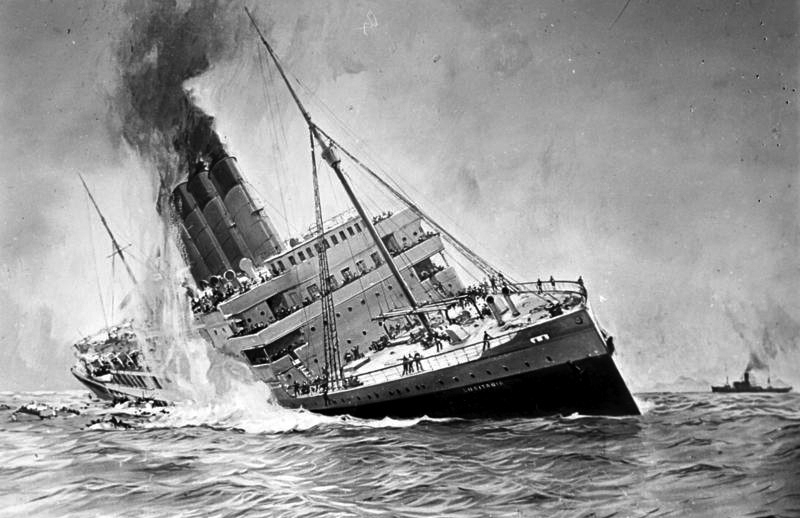
World War I maritime disaster. Image: Unknown Unknown · CC BY-SA 3.0 de · Wikimedia Commons
On 7 May 1915, the great British ocean liner Lusitania was torpedoed by a German submarine off the coast of Ireland. She sank in just eighteen minutes, and 1,198 of the 1,959 people on board died.
The dead included 128 Americans, and the sinking shocked the world. It turned American opinion against Germany and became one of the steps on the road that led the United States into the First World War two years later.
Key Facts
['Date', '7 May 1915']
['Ship', 'RMS Lusitania, a British Cunard ocean liner']
['Attacker', 'The German submarine U-20']
['Place', 'Off the Old Head of Kinsale, Ireland']
['Died', '1,198 of the 1,959 people on board, including 128 Americans']
['Sank in', 'Only 18 minutes']
A warning ignored
Germany had declared the waters around Britain a war zone, where its submarines — U-boats — would sink ships without warning. The German embassy in Washington even placed newspaper advertisements warning travellers not to sail on Allied ships.
Few passengers took the warning seriously. The Lusitania was one of the fastest liners afloat, and her captain believed speed would keep her safe. She left New York on 1 May 1915 with 1,959 people on board.
One torpedo, eighteen minutes
On the afternoon of 7 May, within sight of the Irish coast, U-20 fired a single torpedo. It struck the liner's side, and a second, larger explosion followed — its cause, probably coal dust or her cargo of rifle ammunition, is still debated.
The great ship listed sharply and sank in eighteen minutes. Many lifeboats could not be launched from the tilted decks, and hundreds of people were carried down with her or died in the cold water before help arrived.
The road to 1917
The sinking caused outrage, above all in the United States, which was still neutral. Under American pressure, Germany limited its submarine attacks for a time.
But in 1917, desperate to win, Germany returned to sinking all ships without warning — and secretly tried to draw Mexico into war against the United States. In April 1917 America declared war on Germany. The Lusitania had been an early step on that road.
Did You Know?
The Lusitania sank so fast that most of her lifeboats could not be launched at all — of 48 boats, only a handful got away safely.