This article is written in English. Choose a language to open an automatic translation by Google Translate. Automatic translations can sometimes get historical names and dates wrong — for full accuracy, read the original English article.
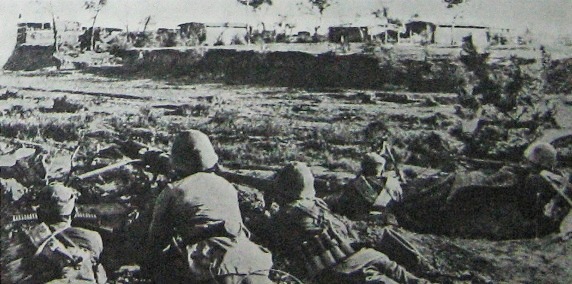
1927–1949 civil war in China. Image: Unknown author Unknown author · Public domain · Wikimedia Commons
From 1927 to 1949, China was torn by a civil war between two great rivals: the Nationalists of Chiang Kai-shek and the Communists of Mao Zedong. Their struggle decided what modern China would become.
Interrupted by Japan's invasion, the war ended in 1949 with a Communist victory. Mao proclaimed the People's Republic of China in Beijing, while Chiang and his government escaped to the island of Taiwan — a division that still exists today.
Key Facts
['When', '1927–1949 (with a pause during the war against Japan)']
['Where', 'China']
['Nationalist leader', 'Chiang Kai-shek']
['Communist leader', 'Mao Zedong']
['Famous episode', 'The Long March, 1934–35']
['Result', "People's Republic of China (1949); Nationalists in Taiwan"]
Partners become enemies
In the 1920s the Nationalists and Communists worked together to unite China against the warlords. But in 1927 Chiang turned on the Communists, killing thousands in Shanghai and other cities.
The surviving Communists fled to the countryside, where Mao built support among the poor peasants by promising land reform. Surrounded by Nationalist armies, in 1934 they broke out and began the Long March — a retreat of some 9,000 kilometres across mountains and marshes that only a fraction survived, but which made Mao their undisputed leader.
War with Japan, then war again
When Japan invaded China in 1937, the two sides made an uneasy truce to fight the invader. The Nationalists bore the main battles and grew weaker and more corrupt; the Communists expanded quietly in the countryside.
When Japan was defeated in 1945, the civil war restarted in full. Despite American weapons, Chiang's armies lost the people's support through inflation, corruption and harsh rule.
1949: a divided China
Communist armies won victory after victory in 1948–49, taking Beijing, Nanjing and Shanghai. On 1 October 1949, Mao stood in Tiananmen Square and proclaimed the People's Republic of China.
Chiang Kai-shek and about two million followers withdrew to Taiwan, keeping the name Republic of China. The two governments have faced each other across the Taiwan Strait ever since — one of the longest-lasting results of any civil war.
Did You Know?
Of the roughly 86,000 Communists who began the Long March, only about 8,000 completed it — yet the march became the founding legend of Communist China.