The Franklin Expedition
This article is written in English. Choose a language to open an automatic translation by Google Translate. Automatic translations can sometimes get historical names and dates wrong — for full accuracy, read the original English article.
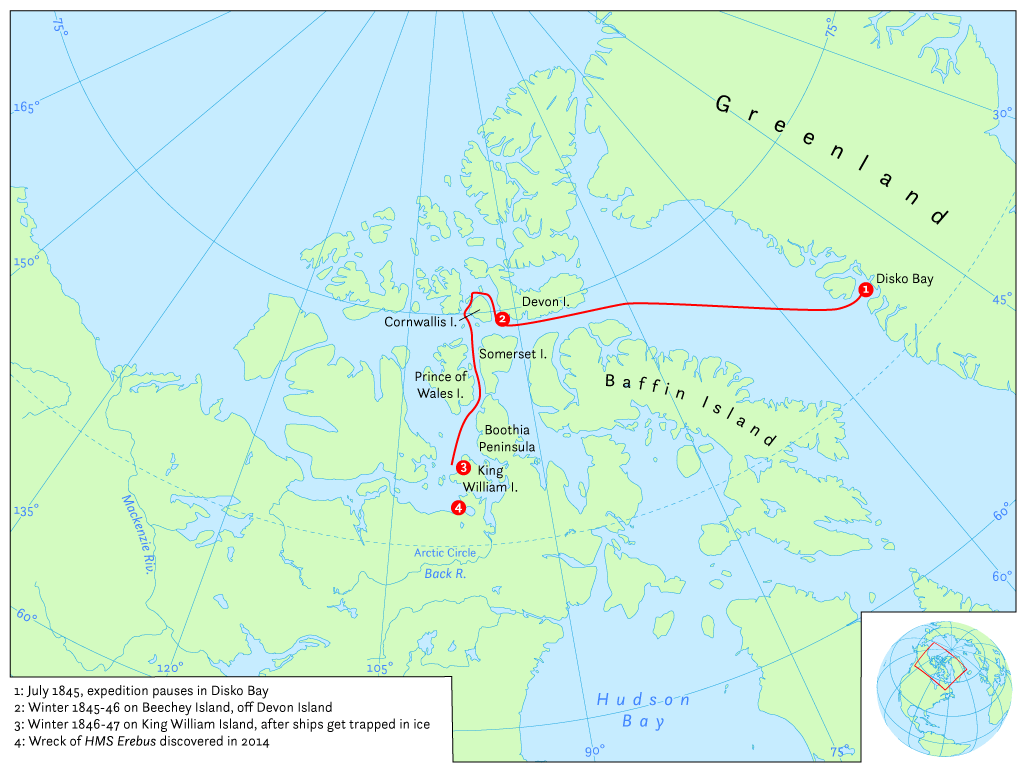
Image: Hans van der Maarel · CC BY-SA 4.0 · Wikimedia Commons
In May 1845, two British ships — HMS Erebus and HMS Terror — sailed into the Canadian Arctic with 129 men, hunting for the Northwest Passage. They carried three years of food, books, and the best technology of their age. None of them ever came home.
For 170 years the Franklin Expedition was the Arctic's greatest mystery. Then, in 2014 and 2016, the ships themselves were found on the seabed — close to where Inuit hunters had always said they were.
Key Facts
- ['The ships', 'HMS Erebus and HMS Terror — strengthened for ice, with steam engines, heating and three years of supplies']
- ['The men', '129 officers and crew under Sir John Franklin']
- ['Last seen', 'By a whaling ship in Baffin Bay in July 1845']
- ['The only message', 'A note found in 1859: Franklin died in June 1847, and 105 survivors were marching south — none arrived']
- ['The search', 'Dozens of expeditions hunted for them; Inuit accounts told the essential truth all along']
- ['The ships found', 'Erebus in 2014 and Terror in 2016 — found with Inuit knowledge guiding the search']
The best-equipped expedition ever sent
Britain had already mapped most of the Arctic coast; one stretch of the Northwest Passage remained, and Franklin was sent to complete it. His ships carried about 8,000 tins of preserved food, libraries of books, musical instruments and even an early photographic camera — floating pieces of Victorian Britain, armoured against the ice.
After a last cheerful meeting with a whaler in Baffin Bay in July 1845, the expedition sailed into Lancaster Sound — and into silence.
Silence — and the great search
When no word came, Franklin's wife Jane drove the Admiralty to search. Expedition after expedition charted the Arctic looking for the lost men. In 1854 Dr John Rae brought back relics bought from Inuit families — and reports that the last survivors, starving, had resorted to cannibalism. Victorian Britain was scandalised; Charles Dickens attacked Rae for believing 'savages' over Englishmen.
In 1859 a search party found the expedition's only written record in a cairn on King William Island: the ships had been trapped in ice since 1846, Franklin was dead, and the 105 survivors had abandoned ship in April 1848 to walk south. Graves, boats and skeletons found along that route told the rest — scurvy, cold, hunger and possibly lead poisoning from the solder of their food tins, a theory scientists still debate.
The ships rise from the deep
For generations, searchers looked in the wrong places — because they had not listened carefully to Inuit testimony, which described a ship sunk far to the south. When Parks Canada renewed the search working with Inuit partners, the wrecks were found quickly: Erebus in 2014, in shallow water south of King William Island.
Two years later, Inuit hunter Sammy Kogvik mentioned a mast he had once seen sticking out of the ice in Terror Bay — and there lay HMS Terror, astonishingly intact, as if her crew had just stepped away. The wrecks are now protected and explored jointly with Inuit communities: the mystery that defeated the Royal Navy was solved by the knowledge of the people who had watched it happen.
Three Franklin sailors buried on Beechey Island in 1846 were exhumed by scientists in the 1980s. The permafrost had preserved them so well that one, John Torrington, seemed merely asleep — his eyes still open after 138 years.
Related Topics
Sources
Reviewed: 22 November 2026
Read this article in the interactive Pastloom reader →