This article is written in English. Choose a language to open an automatic translation by Google Translate. Automatic translations can sometimes get historical names and dates wrong — for full accuracy, read the original English article.
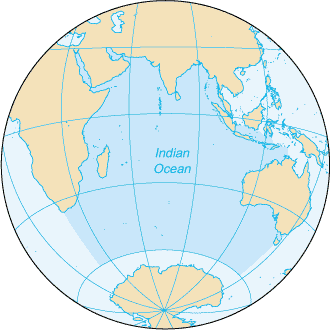
Map of The Indian Ocean with English captions. Image: United States Central Intelligence Agency · Public domain · Wikimedia Commons
Long before European ships reached Asia, the Indian Ocean was the world's greatest trading sea. Guided by the monsoon winds, ships carried pepper, cotton cloth, ivory and gems between India, Arabia, East Africa and South-East Asia.
This trade linked three continents for more than 2,000 years. It made port cities rich, carried religions and languages across the water, and joined the world together centuries before Columbus sailed.
Key Facts
['The secret', 'Monsoon winds — blowing one way in summer, the other in winter']
['From India', 'Pepper and spices, cotton cloth, gems, ivory']
['To India', 'Gold, wine, horses, glass and silver']
['Partners', 'Rome, Arabia, Persia, East Africa, South-East Asia, China']
['Great ports', 'Muziris and Bharuch in India; later Calicut and Aden']
['Changed', "1498 — Vasco da Gama's sea route brought armed European traders"]
Sailing on the monsoon
Indian Ocean sailors learned the ocean's great rhythm: in summer the monsoon winds blow towards India, and in winter they blow back. A ship could ride the wind out, trade, and ride the opposite wind home.
By about 2,000 years ago, Greek and Roman sailors had learned the direct open-sea route to India. Roman ships crowded the port of Muziris for black pepper — so valued in Rome that people called it black gold.
A sea of many peoples
Arab and Persian merchants sailed to India and on to the islands of spices; Indian traders settled in South-East Asia, bringing Hindu and Buddhist ideas with them. On the other side, ships linked India to the Swahili coast of East Africa, trading for ivory and gold.
Chinese ships joined too — in the 1400s the great treasure fleets of Zheng He visited Indian ports. In the ports, Tamil, Arabic, Persian, Swahili and Malay were all heard in the same market.
The Portuguese shock
In 1498 the Portuguese captain Vasco da Gama reached Calicut with the help of a local pilot. Unlike earlier traders, the Portuguese came with cannons and forts, determined to control the trade by force.
The old free-trading world of the Indian Ocean slowly gave way to European sea empires. But the monsoon trade never died — dhows still sail its routes today, following winds their captains have known for a hundred generations.
Did You Know?
The Roman writer Pliny complained that India, Arabia and China drained Rome of gold every year — Rome's love of pepper and silk was costing the empire a fortune.