This article is written in English. Choose a language to open an automatic translation by Google Translate. Automatic translations can sometimes get historical names and dates wrong — for full accuracy, read the original English article.
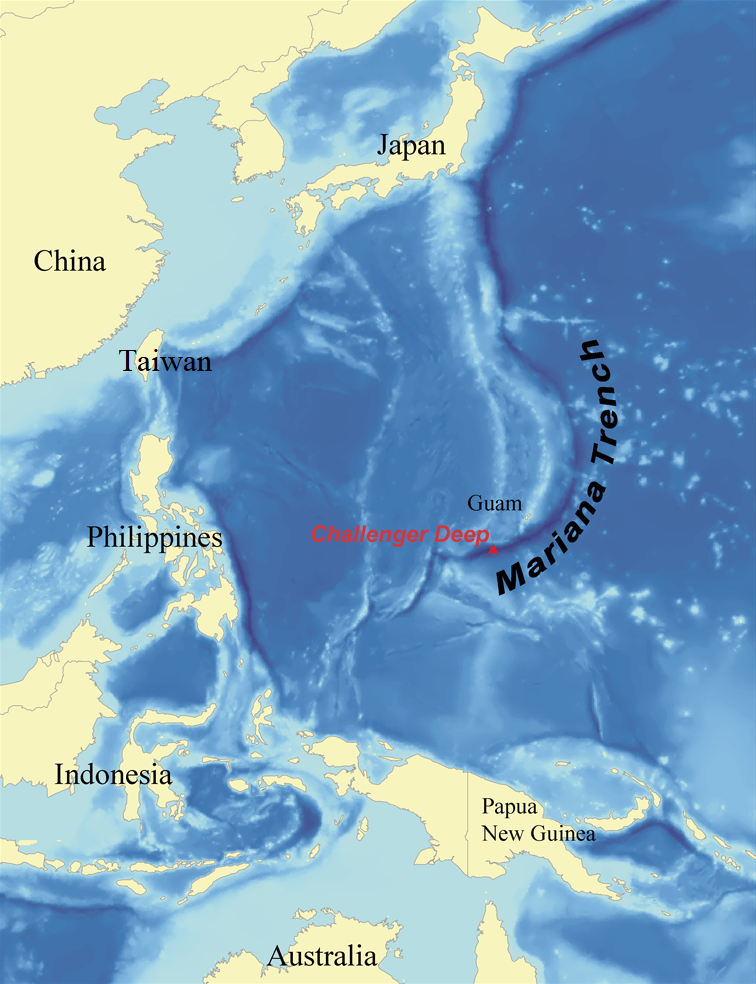
Map showing the location of the Mariana Trench . Image: wallace · CC BY 2.5 · Wikimedia Commons
The Mariana Trench is the deepest place in the world's oceans — a great crack in the floor of the Pacific Ocean, east of the Mariana Islands.
At its deepest point, called Challenger Deep, the sea floor lies nearly 11 kilometres below the surface. If Mount Everest stood in the trench, its peak would still be under water.
Key Facts
['Depth', 'About 10,935 metres at Challenger Deep, the deepest point']
['Where', 'The western Pacific Ocean, east of the Mariana Islands']
['Shape', 'A crescent about 2,550 km long']
['First descent', '1960 — Jacques Piccard and Don Walsh in the bathyscaphe Trieste']
['First solo descent', 'James Cameron, in 2012']
['Pressure', 'More than 1,000 times the pressure at the surface']
The deepest place on Earth
The trench forms where one of Earth's great plates dives beneath another, bending the sea floor down into a long, deep scar. It was first measured in the 1870s by the survey ship Challenger, whose name the deepest point still carries.
For almost a century after that, no one could go there. The pressure at the bottom would crush a normal submarine instantly, and the water is near freezing and totally dark.
Two men at the bottom
In 1960, the bathyscaphe Trieste — a steel sphere hung beneath a huge float — carried the Swiss explorer Jacques Piccard and the American naval officer Don Walsh down for nearly five hours.
At the bottom they saw pale flatfish and shrimps, proving that life could survive even there. Their record stood unmatched for decades: no one returned to Challenger Deep until 2012, when the film-maker James Cameron dived there alone.
Life in the darkness
Scientists once thought nothing could live under such pressure. Instead, the trench is full of life — strange fish, giant single-celled creatures, and shrimps that thrive in the dark.
Sadly, explorers have also found traces of human pollution even at the bottom of the sea. The deepest place on Earth is not beyond our reach — in any sense.
Did You Know?
If Mount Everest were dropped into the Mariana Trench, its summit would still be more than two kilometres below the waves.