This article is written in English. Choose a language to open an automatic translation by Google Translate. Automatic translations can sometimes get historical names and dates wrong — for full accuracy, read the original English article.
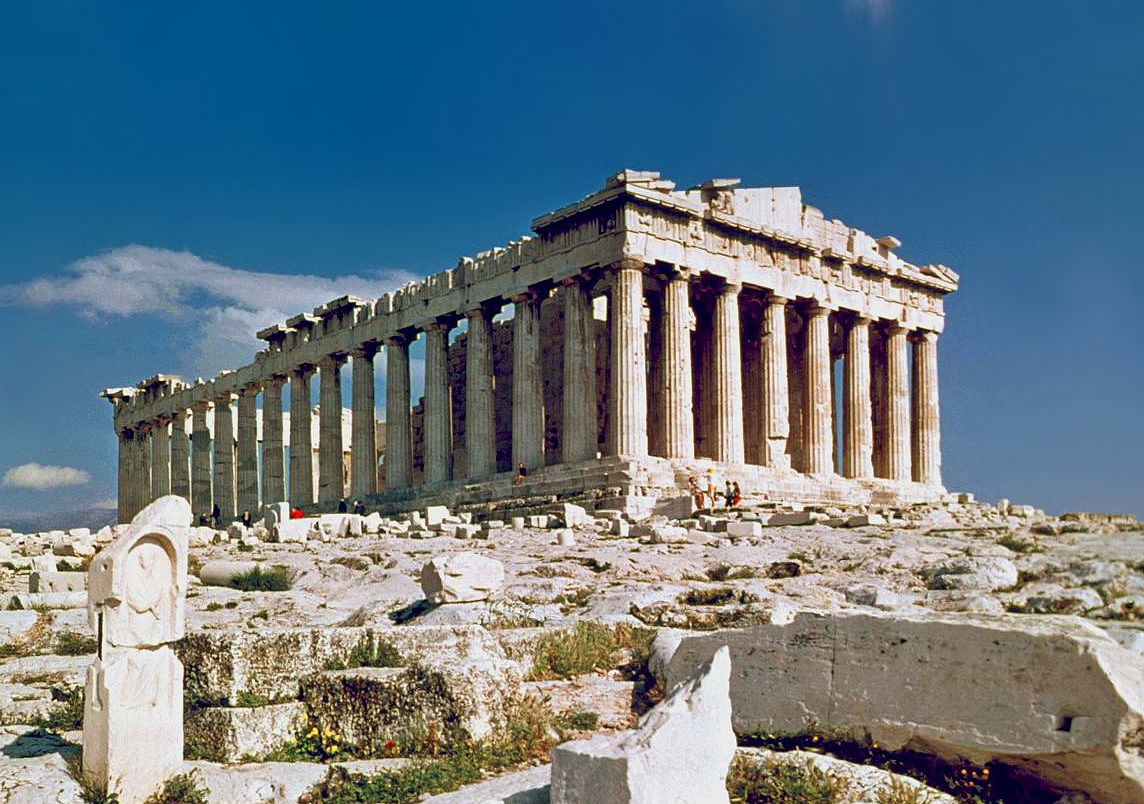
Parthenon, Athens Greece. Photo taken in 1978. Image: Steve Swayne · CC BY 2.0 · Wikimedia Commons
The Parthenon is the great marble temple that stands on the Acropolis, the rocky hill above Athens. It was built between 447 and 432 BCE as the home of Athena, the goddess who protected the city.
Nearly 2,500 years later, it is still the most famous building of ancient Greece — a symbol of Athens, of democracy, and of beautiful, careful design.
Key Facts
['Where', 'The Acropolis of Athens, Greece']
['Built', '447 – 432 BCE']
['Dedicated to', 'Athena, goddess of wisdom and war']
['Ordered by', 'Pericles, leader of Athens']
['Architects', 'Iktinos and Kallikrates']
['Statue inside', 'Athena in gold and ivory, by the sculptor Phidias']
A temple built to be perfect
After the Persians burned the old temples of Athens, the leader Pericles decided to rebuild the Acropolis in shining white marble. The Parthenon was the greatest of the new buildings, paid for with the treasury of Athens' league of allies.
Inside stood a colossal statue of Athena, about 12 metres tall, made of ivory and more than a tonne of gold. The temple's carved decorations showed processions, battles and stories of the gods.
Built with clever tricks
The Parthenon looks perfectly straight — but it has almost no straight lines at all. Its columns lean very slightly inward and swell gently in the middle, and the whole floor curves up by a few centimetres.
These tiny tricks, worked out by Greek builders, correct the tricks our eyes play on us. Without them, a building this size would look as if it were sagging. It is one reason the Parthenon still looks so calm and balanced.
Church, mosque, ruin, symbol
The Parthenon served as Athena's temple for nearly 1,000 years, then became a Christian church, and later a mosque under Ottoman rule. In 1687, during a war, gunpowder stored inside exploded and tore the building apart.
In the early 1800s, many of its sculptures were taken to London, where they remain in the British Museum — Greece still asks for their return. Slow, careful restoration of the temple itself continues in Athens today.
Did You Know?
There is not a single truly straight line in the Parthenon's columns or steps — every 'straight' part is curved by a few centimetres on purpose, so that it looks straight to the human eye.