This article is written in English. Choose a language to open an automatic translation by Google Translate. Automatic translations can sometimes get historical names and dates wrong — for full accuracy, read the original English article.
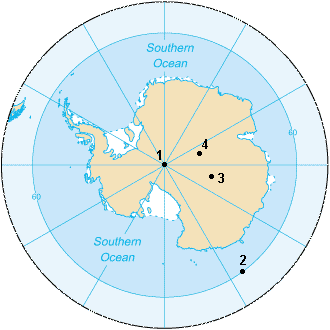
Southernmost point on Earth. Image: · Public domain · Wikimedia Commons
The South Pole is the southernmost point on Earth. It stands on the high ice sheet of Antarctica, the coldest, windiest and driest continent on the planet.
In 1911 two expeditions raced to reach it — Roald Amundsen of Norway and Robert Falcon Scott of Britain. One team came home in triumph; the other became the most famous tragedy in exploration.
Key Facts
['Where', 'On the Antarctic ice sheet, about 2,835 metres above sea level']
['First reached', "14 December 1911, by Roald Amundsen's Norwegian team"]
["Scott's team", 'Arrived 17 January 1912; all five men died on the return journey']
['Coldest place', 'Antarctica holds the world record: about −89 °C measured at Vostok Station']
['Research station', 'The Amundsen–Scott South Pole Station, run by the USA since 1956']
['Protected', 'The Antarctic Treaty of 1959 keeps the continent for peace and science']
The heroic age of Antarctic exploration
For centuries, maps showed a mysterious southern land that no one had seen. Sailors sighted Antarctica around 1820, and by 1900 expeditions were wintering on its ice and sledging into the unknown.
Ernest Shackleton came within 180 kilometres of the Pole in 1909 and turned back to save his men. The stage was set for a final race — and two very different leaders prepared to run it.
Amundsen and Scott
Amundsen planned like a scientist: skis, dog teams, carefully placed food depots, and lessons learned from Arctic peoples. His team reached the Pole on 14 December 1911 and returned safely, every man well.
Scott's British team hauled their sledges by hand and reached the Pole five weeks later, finding the Norwegian flag already there. On the journey back, all five men died in the cold — their diaries and letters, found months later, made them heroes of endurance.
A continent for science
In 1956 the United States built a station exactly at the Pole, later named Amundsen–Scott after the two rivals. Scientists there study the clearest skies on Earth, drill deep ice cores that record ancient climates, and watch for particles from space.
Under the Antarctic Treaty, no nation owns the continent and armies are banned. The bottom of the world belongs to science — a fitting end to its story of rivalry.
Did You Know?
Amundsen's secret weapon was respect for Arctic knowledge: his men wore Inuit-style clothing, travelled light on skis, and let dogs do the hauling — and every one of them came home.