This article is written in English. Choose a language to open an automatic translation by Google Translate. Automatic translations can sometimes get historical names and dates wrong — for full accuracy, read the original English article.
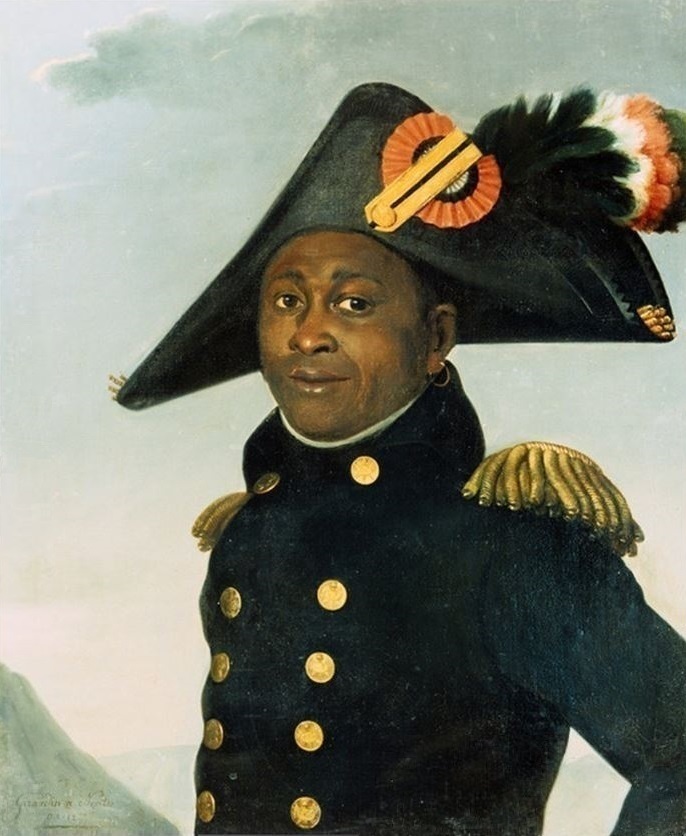
A portrait of Toussaint Louverture Oil on Canvas, 65.1 x 54.3 cm. (25.6 x 21.4 in.) bostonhaitian.com. Image: Alexandre-François-Louis, comte de Girardin · Public domain · Wikimedia Commons
Toussaint Louverture was born enslaved on a sugar plantation in the French colony of Saint-Domingue — and rose to lead the only slave revolt in history that succeeded in founding a free state: Haiti.
A brilliant general and statesman, he defeated Spanish, British and French armies in turn. He died in a French prison in 1803, one year before Haiti won the independence he had made possible.
Key Facts
['Born', 'About 1743, on a plantation in Saint-Domingue (now Haiti)']
['Born into', 'Slavery — freed in the 1770s']
['Led', 'The Haitian Revolution, from 1791']
['Name', "'Louverture' means 'the opening'"]
['Captured', '1802 — sent to France']
['Died', '1803, in a French prison']
Born into slavery
Toussaint was born on the Breda plantation near Cap-Francais. Unusually for an enslaved man, he was taught to read and write, worked as a coachman and livestock steward, and was freed while still a young man.
Saint-Domingue was the richest sugar colony on Earth — and one of the cruellest, worked by half a million enslaved Africans. In August 1791, inspired partly by the French Revolution's talk of liberty, the enslaved rose in revolt.
The uprising of 1791
Toussaint joined the revolt and quickly became its finest general. He trained ragged bands into a disciplined army, and earned his name Louverture — 'the opening' — because he always found an opening in the enemy's lines, some said, or in every negotiation.
France abolished slavery in its colonies in 1794, and Toussaint became a French general. He then defeated the Spanish and the British, who had invaded hoping to seize the colony, and by 1801 he governed all of Saint-Domingue.
A leader fighting empires
Toussaint's constitution of 1801 made Saint-Domingue a self-governing land with slavery abolished forever — and made him governor for life. Napoleon, planning to restore slavery, sent a great expedition to crush him.
In 1802 Toussaint was seized by treachery at a meeting and shipped to France, where he died in a cold mountain prison in April 1803. But his generals fought on, defeated the French, and on 1 January 1804 declared the independent nation of Haiti.
Did You Know?
As he was forced onto the ship to France, Toussaint is said to have warned his captors: 'In overthrowing me, you have cut down only the trunk of the tree of liberty. It will grow back from the roots.'