This article is written in English. Choose a language to open an automatic translation by Google Translate. Automatic translations can sometimes get historical names and dates wrong — for full accuracy, read the original English article.
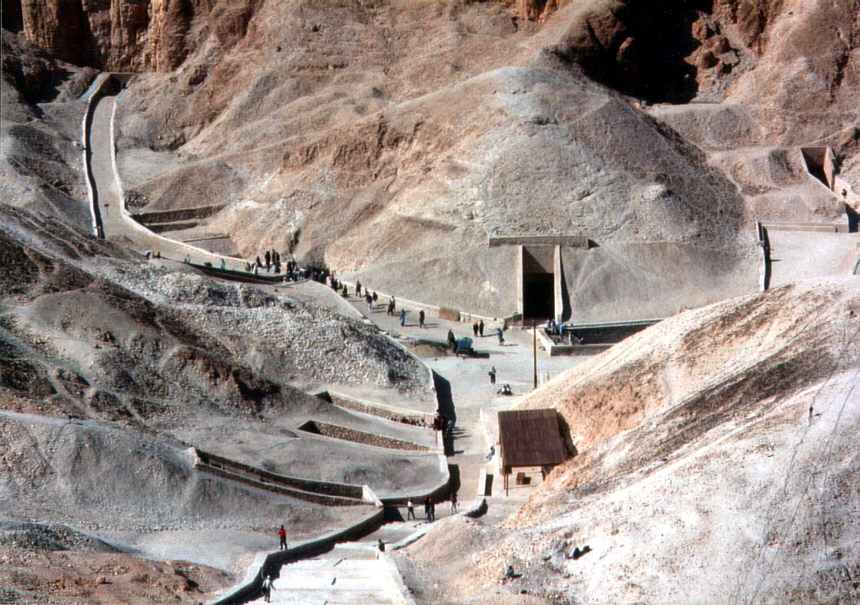
Luxor (Egypt): Valley of the Kings. Image: Fotograf/Photographer: Peter J. Bubenik (1995) · CC BY-SA 2.0 · Wikimedia Commons
The Valley of the Kings is a dry, hidden valley near the ancient city of Thebes (modern Luxor) where the pharaohs of Egypt were buried for about 500 years.
Instead of building huge pyramids that robbers could easily find, the kings of the New Kingdom cut deep tombs into the rock of this valley and filled them with treasure.
Key Facts
['Where', 'West bank of the Nile, near Luxor']
['Used', 'About 1539 to 1075 BCE']
['Tombs known', 'More than 60']
['First king buried there', 'Thutmose I (his tomb is among the earliest)']
['Most famous tomb', 'KV62 — Tutankhamun, found in 1922']
['Guarded by', 'A small pyramid-shaped mountain above the valley']
Why a hidden valley
The great pyramids had all been robbed in ancient times. The New Kingdom pharaohs wanted a safer resting place, so they chose a lonely valley in the desert hills, far from the river and hidden from view.
Workmen who built the tombs lived in a special village, Deir el-Medina, and walked over the hills to work in secret. Even so, tomb robbers still found many of the tombs.
Inside the tombs
A royal tomb was a long passage cut deep into the rock, with stairs, corridors and painted rooms. The walls glow with scenes from the journey of the soul — gods, spells and the king meeting Ra, the sun god.
At the end lay the burial chamber, where the mummy rested inside nested coffins and a stone sarcophagus, surrounded by furniture, food, jewellery and statues for the afterlife.
The tomb that survived
Almost every tomb in the valley was robbed in ancient times — except one. In November 1922 the archaeologist Howard Carter found the nearly untouched tomb of Tutankhamun, hidden under rubble and workmen's huts.
Its more than 5,000 golden treasures amazed the world. Today the valley is one of Egypt's most visited places, and archaeologists still study and protect its painted tombs.
Did You Know?
Tutankhamun's tomb survived because it was small, quickly forgotten, and accidentally buried under debris from a later tomb built above it.