This article is written in English. Choose a language to open an automatic translation by Google Translate. Automatic translations can sometimes get historical names and dates wrong — for full accuracy, read the original English article.
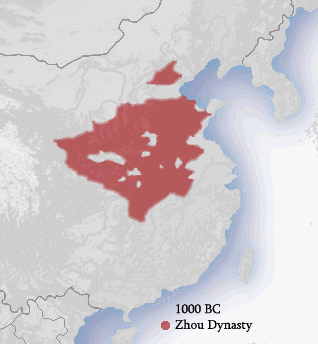
The approximate territory of the Zhou dynasty in China. Drawn by Ian Kiu. Derived from China_map.png by Nat. Image: Territories_of_Dynasties_in_China.gif : Ian Kiu · CC BY-SA 3.0 · Wikimedia Commons
The Zhou dynasty is the longest in Chinese history, lasting from about 1046 to 256 BCE — nearly 800 years. It began with strong kings and ended with them as powerless figureheads.
The Zhou gave China two of its deepest ideas: the Mandate of Heaven, which explained why dynasties rise and fall, and the teachings of Confucius and Laozi, born in the dynasty's troubled later centuries.
['Great thinkers', 'Confucius and Laozi lived in late Zhou times']
['Ended', 'Absorbed by Qin in 256 BCE; China unified in 221 BCE']
Kings and feudal lords
After defeating the Shang, the Zhou kings shared out land to relatives and allies, who ruled local states and owed the king loyalty and soldiers. For generations the system worked.
Zhou ritual, music and bronze inscriptions set the pattern of Chinese civilisation, and Zhou kings ruled as Sons of Heaven.
The long decline
In 771 BCE invaders sacked the western capital, and the court fled east to Luoyang. From then on the Zhou kings kept their titles but lost their power.
Their former vassal states became independent kingdoms. The age that followed — the Spring and Autumn period, then the Warring States period — was full of war, but also of brilliant thought.
Confucius and Laozi
In these troubled centuries, the teacher Confucius taught that order comes from virtue, respect and good rulers setting an example. His ideas became the heart of Chinese education and government.
Tradition also places Laozi, founder of Daoism, in this age. Between them, Zhou-age thinkers gave China philosophies that still guide hundreds of millions of lives.
Did You Know?
Confucius himself was a Zhou-dynasty teacher who could not find a ruler willing to follow his advice — his teachings only conquered China after his death.