This article is written in English. Choose a language to open an automatic translation by Google Translate. Automatic translations can sometimes get historical names and dates wrong — for full accuracy, read the original English article.
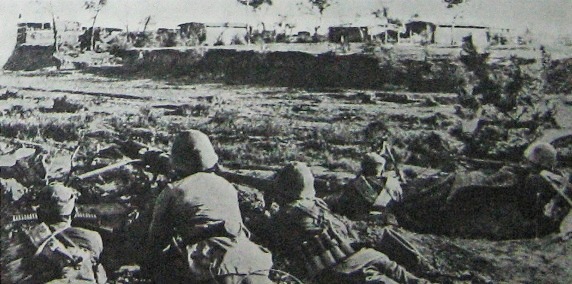
1927–1949 civil war in China. Image: Unknown author Unknown author · Public domain · Wikimedia Commons
The Chinese Civil War was the long struggle between China's Nationalists and Communists for control of the country. It ended in 1949 with a victory that split China in two — a division that still exists today.
On one side stood Chiang Kai-shek's Nationalist government; on the other, Mao Zedong's Communists, who won the support of millions of poor peasants with promises of land and a new China.
Key Facts
['When', 'Mainly 1927 – 1949, with a truce during the war against Japan']
['Sides', 'Nationalists (Kuomintang) against Communists']
['Leaders', 'Chiang Kai-shek against Mao Zedong']
['Turning point', 'The Long March, 1934–35, saved the Communists']
['Result, 1949', "People's Republic of China on the mainland"]
['Other result', 'The Nationalists withdrew to Taiwan']
Two parties become enemies
In the 1920s the Nationalists and Communists first worked together to unite China against warlords. But in 1927 Chiang Kai-shek turned on the Communists, and civil war began.
Driven into the countryside, the Communists built peasant armies and base areas. Chiang's repeated campaigns to destroy them nearly succeeded — until the Communists escaped on the Long March and rebuilt in the north-west.
War with Japan, then war again
When Japan invaded in 1937, the two sides made an uneasy truce to resist the invader. The Nationalists bore the main battles and grew exhausted and corrupt; the Communists expanded behind Japanese lines.
When Japan surrendered in 1945, the civil war resumed in full. Despite American aid, the Nationalists lost the people's support as prices soared and corruption spread.
1949: one war, two Chinas
In 1949 Communist armies took city after city. On 1 October, Mao Zedong proclaimed the People's Republic of China in Beijing.
Chiang and his government fled to the island of Taiwan, where the Republic of China continued. Both sides claimed to be the one true China — and the division created by the civil war still shapes Asia today.
Did You Know?
The civil war produced one of history's great population shifts: about two million Nationalist soldiers, officials and refugees crossed to Taiwan in 1949.