This article is written in English. Choose a language to open an automatic translation by Google Translate. Automatic translations can sometimes get historical names and dates wrong — for full accuracy, read the original English article.
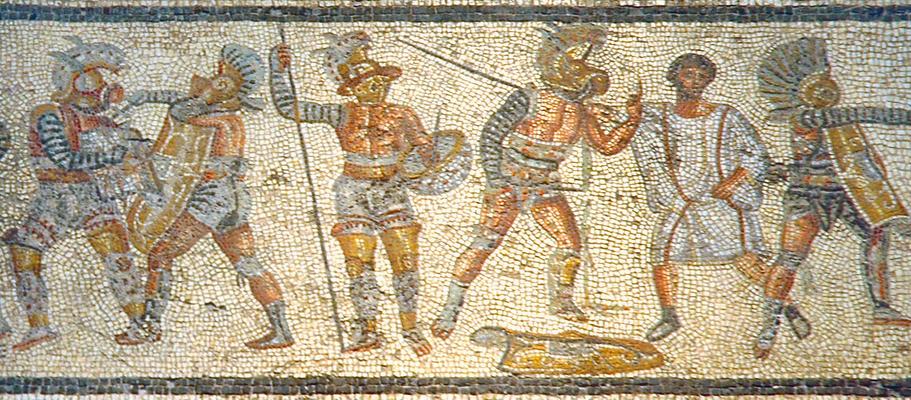
Gladiators from the Zliten mosaic. Image: Unknown author Unknown author · Public domain · Wikimedia Commons
Gladiators were fighters who battled in front of large crowds in ancient Rome. They fought each other, and sometimes wild animals, in great arenas such as the Colosseum.
Many gladiators were slaves or prisoners of war, but a successful gladiator could become rich and famous — and could even win his freedom.
Key Facts
['Name comes from', 'Gladius — the short Roman sword']
['First recorded games', '264 BCE, at a funeral in Rome']
['Most famous arena', 'The Colosseum, opened in 80 CE']
['Colosseum crowd', 'About 50,000 people']
['Famous rebel', 'Spartacus, who led a slave revolt in 73 BCE']
['Prize for freedom', 'A wooden sword, called a rudis']
Who became a gladiator?
Most gladiators were slaves, prisoners of war or criminals, sent to special schools where trainers taught them to fight. A few free men volunteered, hoping for money and fame.
Gladiators were valuable property, so they were fed well and given medical care. They fought only a few times a year, and many fights did not end in death — a beaten fighter could often beg for mercy.
Different kinds of fighters
Each gladiator fought in a set style. The murmillo carried a big shield and a short sword. The retiarius fought with a net and a three-pointed spear, trying to trap his enemy.
Crowds loved these uneven matches — speed against strength, light armour against heavy. Winners became celebrities, and children played with clay figures of their favourite fighters.
Spartacus and the end of the games
In 73 BCE, a gladiator named Spartacus escaped with about seventy others and raised a huge army of slaves. Rome needed two years and several armies to defeat him.
Over time, Roman emperors and Christian teaching turned against the games. Gladiator contests slowly faded and ended by about the 400s CE — but gladiators still star in books and films today.
Did You Know?
A gladiator who won his freedom was given a wooden sword called a rudis — the symbol that he would never have to fight again.