Inside a Gladiator School
This article is written in English. Choose a language to open an automatic translation by Google Translate. Automatic translations can sometimes get historical names and dates wrong — for full accuracy, read the original English article.
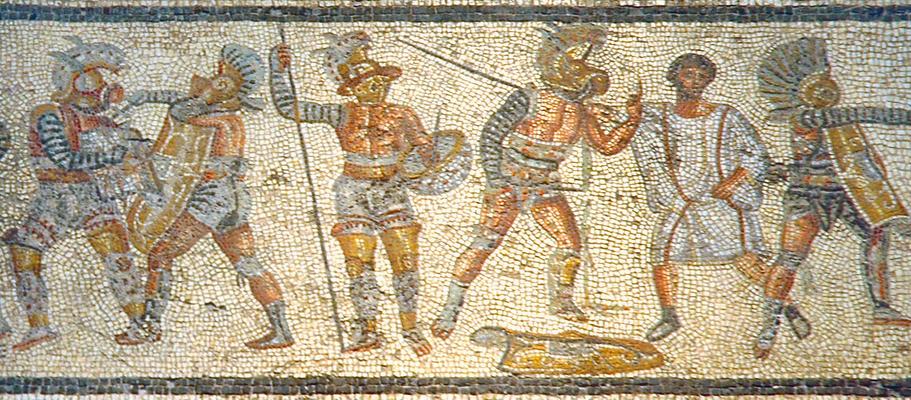
Image: Unknown author Unknown author · Public domain · Wikimedia Commons
Every gladiator was made, not born. Behind the roar of the Colosseum stood special schools — called ludi — where fighters lived, trained, ate and slept under strict rules.
This article goes inside one of those schools: how a new arrival was tested, trained with wooden swords, fed on barley, and cared for by some of the best doctors in Rome.
Key Facts
- ['School name', 'A ludus — the biggest was the Ludus Magnus, beside the Colosseum']
- ['Owner-manager', 'The lanista, who bought, trained and hired out fighters']
- ['Trainers', 'Doctores — often retired gladiators']
- ['Training weapons', 'Wooden swords, so fighters learned without killing each other']
- ['Food', 'Huge meals of barley and beans — gladiators were nicknamed barley-men']
- ['Famous doctor', 'Galen, the great physician, began by treating gladiators']
Arrival, the oath and the training day
New gladiators arrived as slaves, prisoners, condemned criminals or hopeful volunteers. Each swore a frightening oath: to endure burning, binding, beating and death by the sword without complaint.
The school doctor examined them, the trainers tested their strength and courage, and each man was assigned a fighting style to suit his body — heavy shield-bearer, net-fighter, or one of many other types.
Fighters drilled for hours against a wooden post, practising thrusts and footwork, then sparred with wooden weapons under the eyes of their doctores.
Training was professional and careful. A dead gladiator earned his owner nothing, so schools protected their investment with rest, massages, baths and good medical care.
Barley, beans and medicine
Gladiators ate enormous, simple meals — so much barley that fans nicknamed them hordearii, the barley-men. The cheap, filling food built strong bodies and a layer of fat that could protect against shallow cuts.
Wounds were treated seriously. The young Galen, later the most famous doctor of the Roman world, learned anatomy and surgery patching up gladiators at Pergamon — experience no medical school could give.
Fame and a way out
Stars of the arena were celebrities: their names were scratched on walls at Pompeii, and fans argued over favourites just as they do with athletes today.
A fighter who survived and pleased the crowds could win the rudis, a wooden sword symbolising freedom. Many freed gladiators chose to stay on — as trainers, passing their skills to the next arrivals.
Archaeologists found a gladiator school at Pompeii and another, almost complete with cells and a training arena, in Austria in 2011 — detected from the air without digging at all.
Related Topics
Sources
Reviewed: 22 November 2026
Read this article in the interactive Pastloom reader →