This article is written in English. Choose a language to open an automatic translation by Google Translate. Automatic translations can sometimes get historical names and dates wrong — for full accuracy, read the original English article.
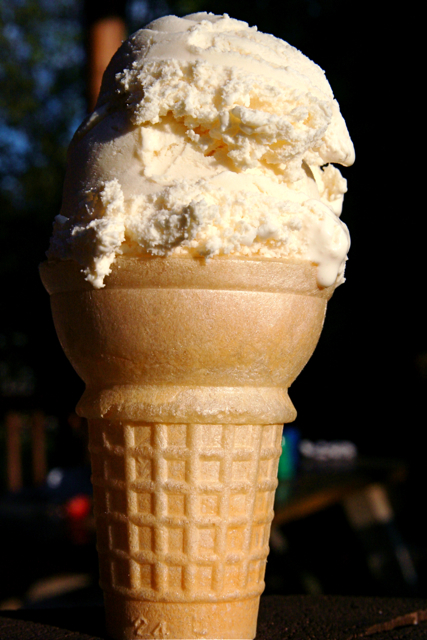
Vanilla ice cream cone I bought at Camp Manitoulin for a $1 donation. It was sort of icey. For Macro Mondays Drips Drops Splashes. Image: Steven Depolo · CC BY 2.0 · Wikimedia Commons
Long before freezers, people in hot lands dreamed of cold sweets. Persians poured grape juice over mountain snow, and Chinese cooks froze sweetened milk mixtures in snow and saltpetre more than a thousand years ago.
Slowly those royal luxuries became ice cream for everyone — through Arab sorbets, Italian gelato, a clever hand-crank machine, and a rolled-up wafer at a world's fair.
Key Facts
['Early forms', 'Snow desserts in Persia and China, over 1,000 years ago']
['Key trick', 'Mixing ice with salt makes it cold enough to freeze cream']
['Spread by', 'Arab sorbets, then Italian and French cooks']
['Home machine', 'Hand-crank freezer, patented 1843 by Nancy Johnson']
['The cone', "Popularised at the St Louis World's Fair, 1904"]
['Today', "One of the world's favourite desserts"]
Snow for kings
In ancient Persia, people stored winter ice in desert ice-houses called yakhchals and poured fruit syrups over snow — a dessert related to today's faloodeh. Chinese emperors enjoyed frozen milk and rice mixtures.
For centuries, iced desserts stayed a luxury of courts, because collecting and storing ice was expensive work.
Sorbets, gelato and a freezing secret
Arab cooks perfected sharbat — chilled fruit drinks and sorbets — and the idea travelled to Sicily and Italy. Italian gelato and French ice cream became famous in the 1600s and 1700s.
The great secret was salt: mixing salt with ice makes a bath far colder than ice alone, cold enough to freeze sweetened cream while it is stirred smooth.
Ice cream for everyone
In 1843, American Nancy Johnson patented a hand-crank freezer that made ice cream easy at home. Factories, ice-cream parlours and street carts followed.
At the 1904 St Louis World's Fair, a wafer-seller rolled his wafers into cones for a neighbouring ice-cream seller who had run out of dishes — or so the famous story goes. The cone turned ice cream into a walking treat for the whole world.
Did You Know?
In 1984, US President Ronald Reagan made July National Ice Cream Month — but Americans were already among the world's biggest ice-cream eaters long before that.