This article is written in English. Choose a language to open an automatic translation by Google Translate. Automatic translations can sometimes get historical names and dates wrong — for full accuracy, read the original English article.
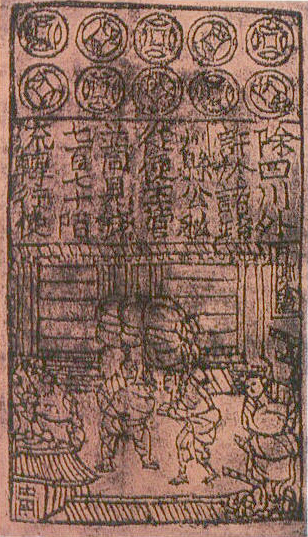
Jiaozi , Early paper money, China, Northern Song Dynasty. Image: Unknown author Unknown author · Public domain · Wikimedia Commons
Paper money is a promise printed on paper: this note stands for real value, and everyone agrees to accept it. It began in China over 1,000 years ago, when merchants grew tired of carrying heavy strings of iron coins.
Light, printable and easy to carry, paper money conquered the world — but only where people trusted the promise behind the paper.
Key Facts
['First paper money', "China — merchants' notes from the Tang age, state notes under the Song, over 1,000 years ago"]
["Marco Polo's wonder", "He described China's paper money with amazement in the 1200s"]
["Europe's first banknotes", 'Sweden, 1661 — issued by the Stockholms Banco']
['Paper that failed', 'Over-printing ruined paper money in China and in revolutionary France']
['Plastic notes', 'Polymer banknotes began in Australia in 1988']
['Today', 'Most money is not paper at all — it is numbers in computers']
China invents the banknote
In Tang and Song China, coins were heavy iron, tied in strings of a thousand. Merchants left their coins with trusted shops and carried paper receipts instead — and the receipts began to pass from hand to hand as money.
The Song government took over the idea, printing official notes with woodblocks, seals and warnings against forgery. Under the Mongol Yuan dynasty, paper money spread across China — the world's first great paper currency.
Paper money reaches Europe
Marco Polo told Europe about money made from the bark of trees, and readers thought he was inventing tales. Europe still trusted only gold and silver coins.
But in 1661, Sweden's Stockholms Banco issued Europe's first true banknotes, because its copper coins were absurdly heavy. London's goldsmiths and then the Bank of England followed — paper promises backed by gold in a vault.
Trust, forgery and the modern note
Paper money's weakness is trust. Governments that printed too much — Yuan China, revolutionary France, and others — watched their notes become worthless paper.
So modern notes fight back with art and science: watermarks, fine engraving, holograms and now plastic polymer. The note in a pocket today is a small masterpiece of printing — still doing the job of China's first paper receipts.
Did You Know?
Marco Polo wrote that Kublai Khan had found the secret of alchemy: his paper money, made from tree bark, was accepted as payment across China as if it were gold.