History of the Internet
This article is written in English. Choose a language to open an automatic translation by Google Translate. Automatic translations can sometimes get historical names and dates wrong — for full accuracy, read the original English article.
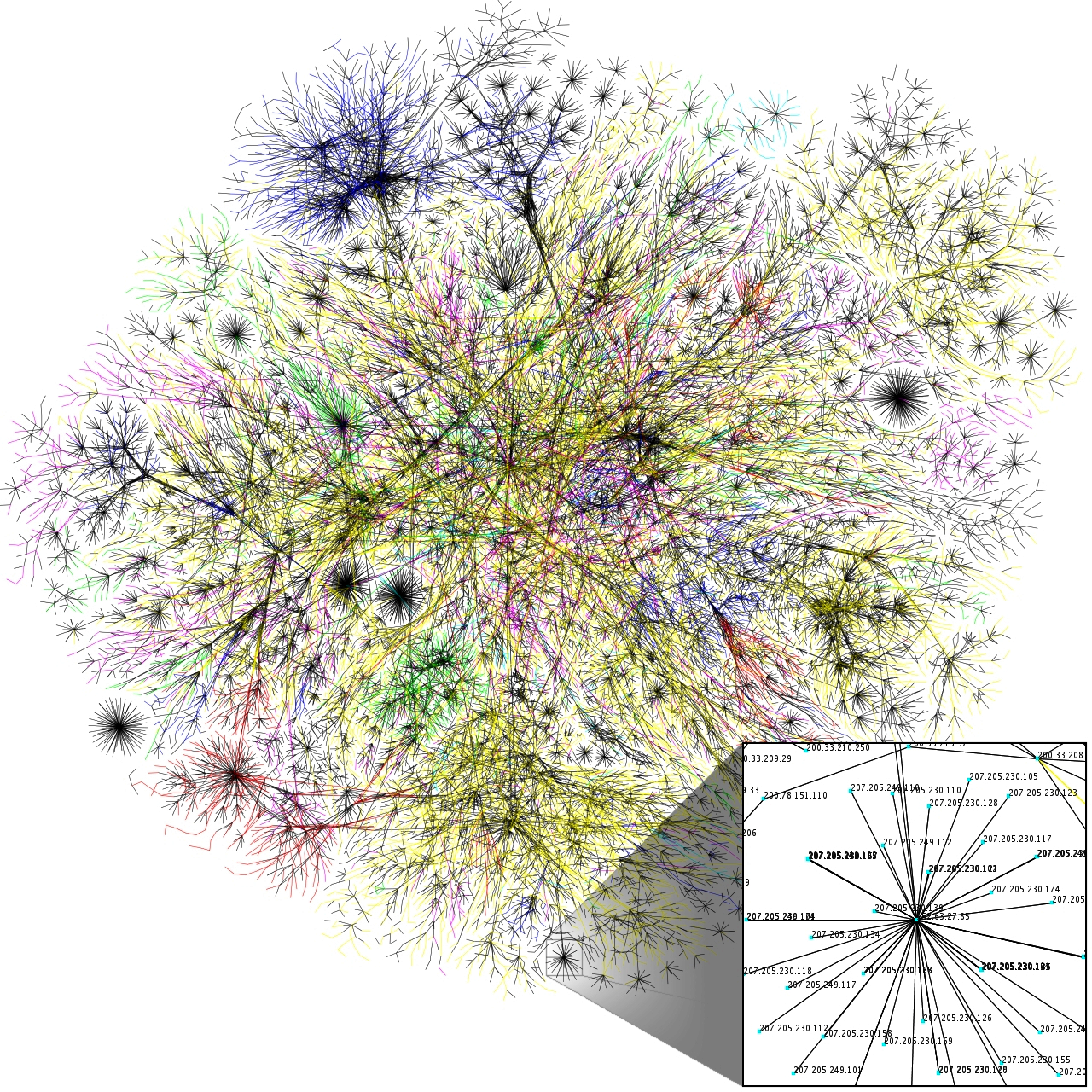
Image: The Opte Project · CC BY 2.5 · Wikimedia Commons
The history of the internet is the story of a Cold War military experiment that escaped the laboratory and connected the world. Begun in 1969 as ARPANET, a small network of four computers, it grew through universities until Tim Berners-Lee's World Wide Web (1989) made it usable by everyone.
Within one human lifetime, the internet went from a defence project to the nervous system of the planet — carrying our mail, money, news, entertainment and friendships.
Key Facts
- ['Ancestor', 'ARPANET, first connected 1969']
- ['Key invention', 'Packet switching; TCP/IP standardised 1983']
- ['The Web', 'Invented by Tim Berners-Lee at CERN, 1989–91']
- ['First website', 'info.cern.ch — still online']
- ['Users today', 'More than 5 billion — over 60% of humanity']
- ['Email began', '1971 — the @ sign chosen by Ray Tomlinson']
Cold War beginnings
The internet was born from a military worry. In the 1960s, the US defence agency ARPA wanted a communications network that could survive the loss of any single part — even, in the darkest version of the story, a nuclear attack. The answer was packet switching: chop messages into small blocks, send each by whatever route is open, and reassemble them at the destination.
In 1969 the first network, ARPANET, linked four university computers. On 29 October, a student tried to send 'LOGIN' from UCLA to Stanford; the system crashed after 'LO'. Through the 1970s the network grew quietly among universities and researchers, and in 1971 Ray Tomlinson added network email — choosing the @ sign to separate user from machine.
One language for all networks
By the early 1980s many separate networks existed but could not talk to each other. The solution, designed by Vint Cerf and Bob Kahn, was TCP/IP — a common set of rules any network could adopt, making a 'network of networks': an internet. On 1 January 1983 ARPANET switched to TCP/IP, a date often called the internet's birthday.
Through the 1980s, academic networks like America's NSFNET linked universities worldwide. The internet was powerful but forbidding — text commands, no pictures, no search. It waited for someone to make it friendly.
The Web changes everything
At CERN, the European physics laboratory, a British scientist named Tim Berners-Lee was frustrated by scattered information. In 1989 he proposed, and by 1991 built, the World Wide Web: pages written in HTML, addressed by URLs, fetched by HTTP, and joined by clickable links — all running on top of the internet. CERN gave the Web away free in 1993, a decision that changed history.
The Mosaic browser (1993) added pictures and point-and-click ease; millions rushed online. Berners-Lee could have patented his invention and been a billionaire; instead the Web belonged to everyone — and exploded: search engines, online shops, social media, streaming, and the smartphone put it in every pocket.
The connected planet
Today more than five billion people use the internet — for banking, medicine, education, revolutions and cat videos alike. It has dissolved distance: a student in Kasur can read the same library as a professor at Oxford; a small shop can sell to the world; news crosses the planet in seconds. It has also brought new troubles — misinformation, surveillance, addiction and crime at network speed.
From four computers in 1969 to a web connecting most of humanity in two generations, the internet is the fastest-spreading technology ever invented. Its history is not finished — it is the medium in which much of future history will happen.
The first message sent over the internet's ancestor, ARPANET, in 1969 was meant to be 'LOGIN'. The system crashed after two letters — so the internet's first word was 'LO'.
Related Topics
Sources
Reviewed: 24 November 2026
Read this article in the interactive Pastloom reader →