This article is written in English. Choose a language to open an automatic translation by Google Translate. Automatic translations can sometimes get historical names and dates wrong — for full accuracy, read the original English article.
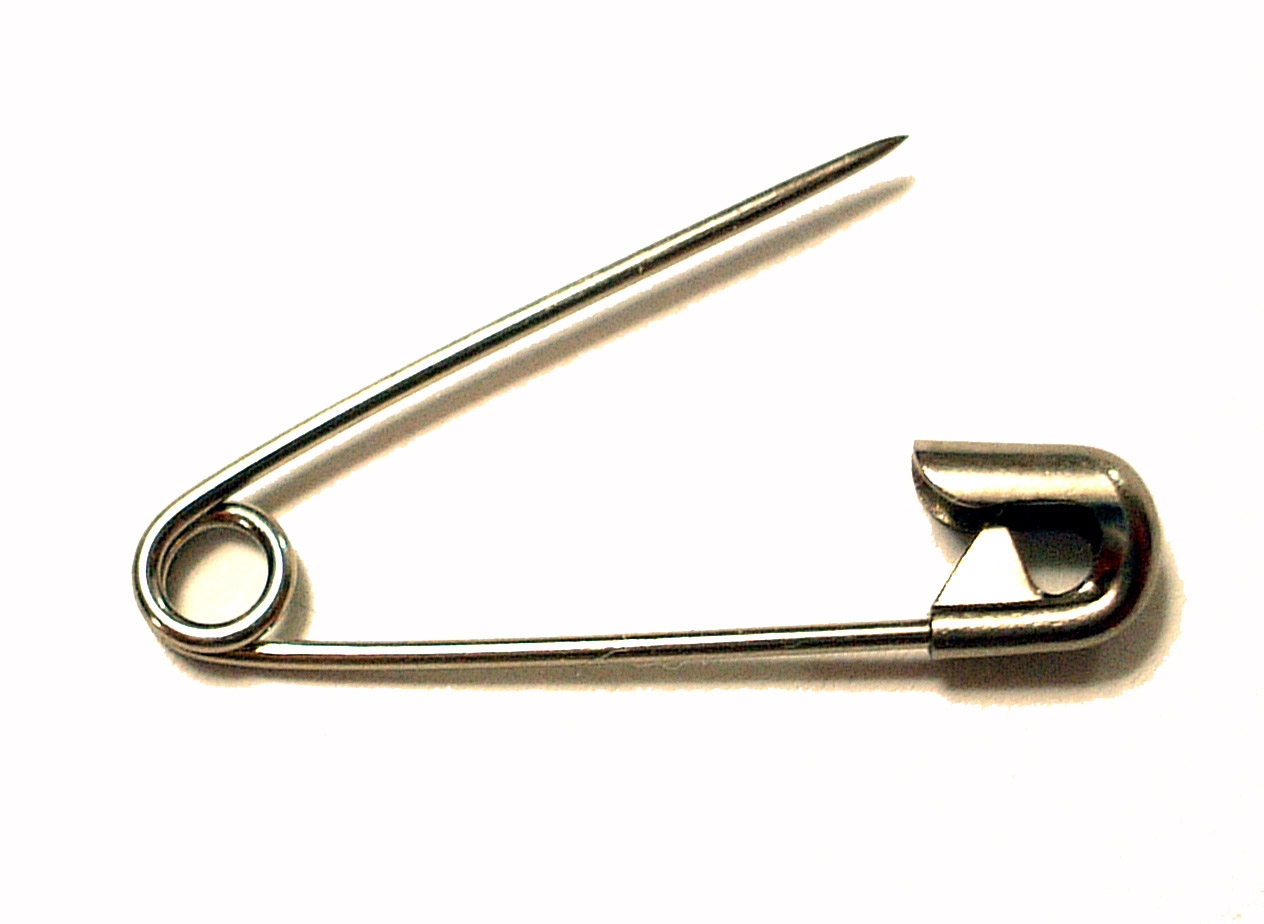
A modern safety pin, open. Its design is almost unchanged from Walter Hunt's 1849 invention. Image: Haragayato · CC BY-SA 3.0 · Wikimedia Commons
The safety pin is a small bent wire with a clasp that covers its sharp point, so it can fasten cloth without pricking anyone. It is one of the simplest and most successful inventions of the 1800s.
An American inventor, Walter Hunt, designed it in 1849 — according to the famous story, in a single afternoon, to pay off a small debt.
Key Facts
['Invented', '1849, by Walter Hunt in New York']
['Patent', 'United States patent 6,281, April 1849']
['Ancient ancestor', 'The fibula — a brooch pin thousands of years old']
['Sold for', 'Hunt sold the rights for about $400']
['Used for', 'Fastening clothes, nappies and bandages']
['Second life', 'A symbol of punk fashion in the 1970s']
From fibula to Hunt
The idea is ancient. Thousands of years ago, Greeks and Romans fastened their clothes with a fibula — a brooch with a spring and a pin that worked much like a safety pin. The design was then forgotten for centuries.
In 1849, the New York inventor Walter Hunt needed to repay a debt of $15. Twisting a piece of brass wire in his workshop, he created the modern safety pin in a few hours — a coil spring at one end, and a clasp at the other that covered the point. He patented it and sold the rights for about $400.
A pin in every home
The safety pin was cheap to make and endlessly useful. It fastened nappies, bandages, curtains and torn clothes, and became a standard item in every sewing box and first-aid kit.
Remarkably, its design has barely changed in more than 175 years. Few inventions have ever been finished so completely at the first attempt.
The pin as a symbol
In the 1970s, punk rockers in Britain wore oversized safety pins through their clothes — and sometimes their ears — as a badge of rebellion, turning a household object into a fashion statement.
In 2016, many people began wearing a small safety pin on their clothing as a quiet symbol that they were a safe person to approach for help. The little pin had become a message as well as a fastener.
Did You Know?
Walter Hunt also built one of the first sewing machines — and gave it up, worrying it would put seamstresses out of work. He sold the safety pin rights for $400; others made fortunes from it.