This article is written in English. Choose a language to open an automatic translation by Google Translate. Automatic translations can sometimes get historical names and dates wrong — for full accuracy, read the original English article.
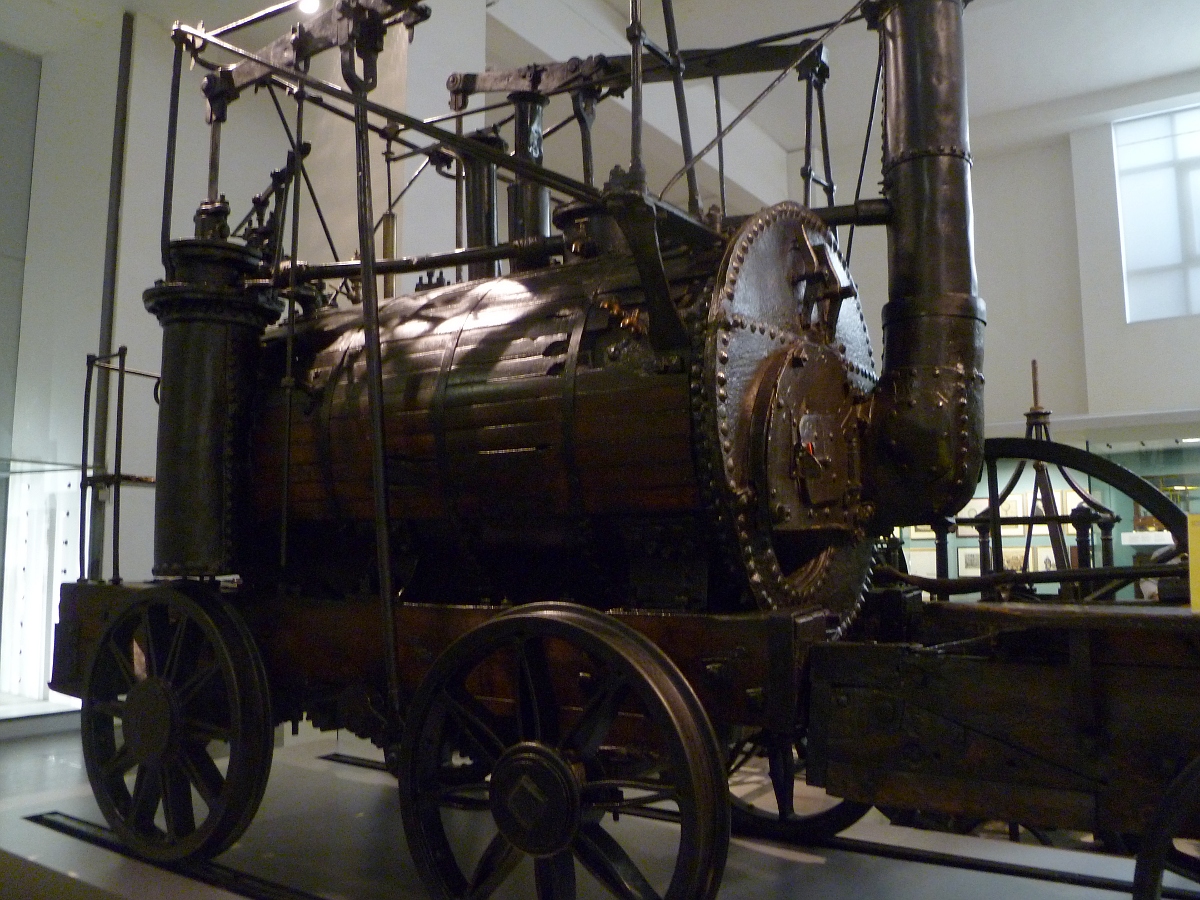
Side view of "Puffing Billy", the oldest surviving steam locomotive in the UK. Taken at the Science Museum, South Kensington, London, UK. Image: Arkady Rose · CC BY-SA 3.0 · Wikimedia Commons
The railway changed the world more than almost any other invention. Before trains, a journey of a hundred miles could take days. After trains, it took hours.
Steam locomotives pulled wagons of coal, then carriages of people, along iron rails. Towns grew around stations, food travelled farther, and ordinary people could travel for the first time in their lives.
Key Facts
['First public steam railway', 'Stockton–Darlington, 1825']
['Famous early locomotive', "Stephenson's Rocket, 1829"]
['First US transcontinental railway', 'Completed 1869']
['Standard track width', '4 feet 8½ inches']
['Power today', 'Mostly electric or diesel']
The first steam trains
The first public steam railway opened in England in 1825, between Stockton and Darlington. It was built to carry coal, but people soon rode on it too.
In 1829, George Stephenson's locomotive, the Rocket, won a famous trial by reaching about 30 miles per hour — faster than a galloping horse. A year later, the Liverpool–Manchester line opened, the first railway built for passengers between two cities.
Railways spread around the world
Railways spread quickly — across Europe, America, India and beyond. They carried coal, steel, grain and goods cheaply, and they let factories sell to far-away towns.
Railways also changed time itself: towns had used their own local time, but train timetables needed one shared time, so standard time was introduced. In the United States, the first railway across the whole continent was finished in 1869.
Trains today
Steam gave way to diesel and then to electric trains. Modern high-speed trains in Japan, China and Europe travel at more than 300 kilometres per hour.
Railways are still one of the cleanest ways to move many people at once. The iron road that began with coal wagons in 1825 still carries millions of people every day.
Did You Know?
Train timetables helped create standard time — before railways, every town kept its own local time.