This article is written in English. Choose a language to open an automatic translation by Google Translate. Automatic translations can sometimes get historical names and dates wrong — for full accuracy, read the original English article.
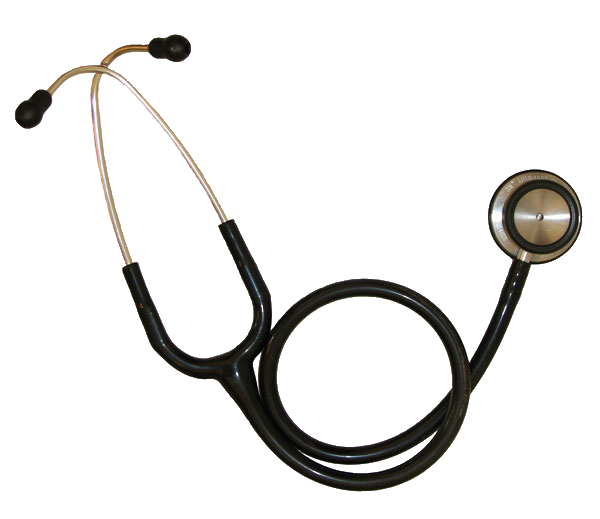
Medical device for auscultation. Image: this version: Sonarpulse . origenal: Huji · Public domain · Wikimedia Commons
The stethoscope is the tube doctors hang around their necks to listen to your heart and lungs. It was invented in Paris in 1816 by a young doctor who felt awkward about pressing his ear directly to a patient's chest — so he rolled up a notebook into a tube.
To his surprise, the tube carried sound better than the bare ear. That paper roll became the most famous medical instrument in the world.
Key Facts
['Inventor', 'René Laennec, a French doctor, in 1816']
['First version', 'A rolled paper tube, then a hollow wooden cylinder']
['Why invented', 'Modesty — and it worked better than the ear alone']
['His book', "Laennec's 1819 book taught doctors to link chest sounds to diseases"]
['Two ears', 'Binaural stethoscopes with two earpieces spread in the 1850s']
['Today', 'Electronic stethoscopes can amplify sound and record it']
A roll of paper in Paris
Before 1816, doctors listened to the chest by pressing an ear straight onto the patient's body — awkward, and not very clear. Examining a young woman one day, René Laennec remembered that sound travels well through solid wood.
He rolled a sheaf of paper into a cylinder and placed one end on her chest. Through it, he heard the heart far more clearly than ever before. He named his instrument from Greek words for 'chest' and 'to look at' — stethoscope.
How the stethoscope grew ears
Laennec spent years matching the sounds he heard — rattles, whistles, murmurs — with what diseases he later found in the body, and published a book that founded modern chest medicine.
His wooden tube slowly evolved: flexible tubing, a bell and diaphragm, and two earpieces by the 1850s. The design settled into the shape every child now draws when playing doctor.
The doctor's symbol
The stethoscope let doctors 'see' inside the living body without cutting — one of the first tools to do so, a generation before X-rays. It changed diagnosis from guesswork about symptoms to detective work with sounds.
Two centuries on, ultrasound and scans have joined it, but the stethoscope remains the emblem of the doctor — and usually the first instrument a medical student ever owns.
Did You Know?
Laennec got his idea from watching children play in a courtyard — one scratched a pin at the end of a long beam of wood while another listened with an ear at the far end.