This article is written in English. Choose a language to open an automatic translation by Google Translate. Automatic translations can sometimes get historical names and dates wrong — for full accuracy, read the original English article.
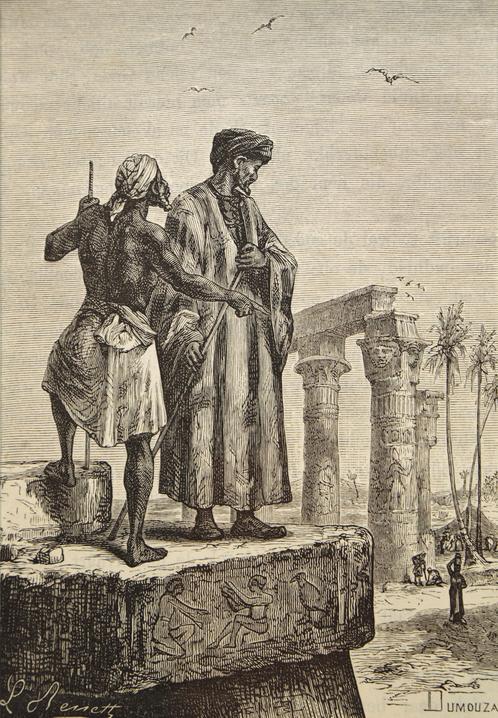
An illustration from Jules Verne 's book "Découverte de la terre" ("Discovery of the Earth") drawn by Léon Benett. Ibn Battuta (1304-68/69) was a Maghrebi Berber scholar and traveller. Image: Léon Benett · Public domain · Wikimedia Commons
In 1325 a young Moroccan named Ibn Battuta left home to make the pilgrimage to Mecca. He did not come back for about 29 years.
In that time he travelled roughly 117,000 kilometres — through Africa, the Middle East, India and China — farther than Marco Polo. The book he dictated about his journeys, the Rihla, is one of the greatest travel accounts of the medieval world.
Key Facts
['Born', '1304, in Tangier, Morocco']
['Travels', '1325 to about 1354']
['Distance', 'About 117,000 km — three times around the Earth']
['Jobs on the road', 'Judge (qadi) in Delhi and the Maldives, envoy and court guest']
['His book', "The Rihla — 'The Travels', dictated after his return"]
['Died', 'About 1368–1369, in Morocco']
A pilgrimage that never stopped
Ibn Battuta set out at twenty-one, alone, riding towards Mecca. He crossed North Africa, visited Egypt, Syria and the holy cities of Arabia, and made the Hajj pilgrimage.
Instead of going home, he kept going: to Persia, East Africa, Anatolia and the lands of the Golden Horde. Each journey suggested another, and the road became his life.
India, the Maldives and China
Crossing the Hindu Kush, he reached India, where the Sultan of Delhi made him a judge. He served for years, fell in and out of favour, and was sent as an envoy towards China.
Shipwreck and adventure followed. He worked as a judge in the Maldives, visited Ceylon and Bengal, and finally reached China — then sailed home by way of Arabia, reaching Morocco in 1349, twenty-four years after leaving.
One more journey — and the book
Even then he was not finished. He crossed the Sahara to the Mali Empire in West Africa, seeing the court of Mansa Sulayman and the trading city of Timbuktu.
At home at last, he told his story to the writer Ibn Juzayy, who shaped it into the Rihla. Because Ibn Battuta saw so much of the 1300s world with his own eyes, historians still mine his book for everyday life across three continents.
Did You Know?
When Ibn Battuta finally returned to Morocco after 24 years away, both his parents had died during his absence — he had left as a young man and came back to a home that no longer existed.